Acrylic Display Staircase Made to Measure — Every Row Stays Visible

Acrylic display case manufactory in Germany for over 20 years

When figures, model cars or goods stand in a row one behind the other, you only see the front one. The made-to-measure staircase tiers them upwards towards the back — you decide the width, depth, height and the number of steps yourself, and the configurator works out step height and step depth from that live. Delivery time approx. 8 working days.

Enter the dimensions · choose the number of steps · order — in about 3 minutes

4 mm stringers & step surfaces Step fronts transparent, black or reflective Plug-and-screw system, delivered disassembled
Schematic drawing of a three-step acrylic staircase with objects arranged in tiers all three rows in view green: the load-bearing step fronts
Schematic drawing — height, depth and the number of steps determine the step profile.

What a made-to-measure display staircase is built for

Six situations that are ordered from us again and again — in the living room just as much as in the shop.

Action figures & collectable figures

Three or four rows of figures on a shelf — without tiering you only see the first. With figures 15–17 cm tall, a step height of 5–7 cm is already enough for the head and weapon of the back row to stand clear.

LEGO® minifigures

Minifigures are only around 4 cm tall: small steps 3–4 cm high and 4–5 cm deep are enough here. Across 60 cm of width that quickly makes 40 figures stand clearly arranged side by side and one behind the other.

Model cars & scale modelling

1:43 and 1:87 benefit most from the tiering — otherwise the models at the back disappear completely. Choose the step depth to suit the longest model and add 1–2 cm of clearance.

Shop windows & sales counters

Cosmetics, jewellery, baked goods, books, electronics: the transparent staircase brings goods up to eye level without drawing attention to itself. Demountable — handy when the display changes regularly.

Collector’s mugs, glasses, miniatures

Anything that stands flat and closely packed gains from being offset in height. Pay particular attention here to sufficient step depth so that nothing overhangs the edge.

A staircase in a display cabinet or under a display case

Very common: the staircase goes under a made-to-measure acrylic display case or into an existing display cabinet. In that case settle the outside dimensions of the staircase first — the display case is then ordered to match.

The calculation that matters: step height and step depth

You do not specify the individual step but the overall dimensions plus the number of steps — from these the configurator divides the staircase up evenly and shows both step dimensions live. It is exactly these two figures that decide whether your objects fit.

Step height = overall height ÷ number of steps Step depth = overall depth ÷ number of steps − 1 mm

That one millimetre is taken off for the material overlap of the step surfaces. The width stays the same across all steps — it is your overall width.

How the four dimensions relate

Side view of a three-step staircase with step height, step depth, staircase height and staircase depth Step height Step depth Staircase height (overall) Staircase depth (overall)

The example staircase has three steps (side view — the width runs across it). You specify the staircase height, the staircase depth (both overall dimensions) and the number of steps; from these follow the step height (the rise from row to row) and the step depth (the standing area of one row).

What the configurator does not allow

Too many steps produce step surfaces that are too narrow for the plug-together system Step depth under 4 cm — too narrow for the plug-together system

That is why the configurator checks as you go: the step depth must be at least 4 cm and the step height must lie between 3 and 50 cm. The reason is manufacturing, not taste: the step surface and the step front are plugged into one another and screwed together — and for that the surface needs a minimum depth. If your number of steps does not suit the dimensions, the configurator says so straight away: reduce the number of steps, or make the staircase deeper or taller.

Example dimensions to borrow

All values rounded, as the configurator displays them. You are not tied to any of these sizes.
Staircase (W × D × H)StepsStep heightStep depthIntended for
25 × 15 × 12 cm34,0 cm4,9 cmLEGO® minifigures, miniatures
30 × 20 × 15 cm35,0 cm6,6 cmModel cars 1:87, small figures
40 × 24 × 18 cm36,0 cm7,9 cmAction figures up to approx. 17 cm
60 × 30 × 20 cm45,0 cm7,4 cmModel cars 1:43, shop counter
80 × 40 × 30 cm56,0 cm7,9 cmShop windows, large collections

How to find your dimensions in three steps

1. Measure the space available — width and depth on the shelf, in the display cabinet or on the counter.
2. Measure a typical object: how deep is it, how tall? The step depth should be 1–2 cm greater than the object depth.
3. Try out different numbers of steps in the configurator — the step height shown decides how much of the back row stays visible. As a rule of thumb: one third to one half of the object height.

The step fronts: load-bearing component and design element in one

The front is the vertical surface between two step surfaces — and at the same time the support beam on which the step surface above it rests. The two are joined by a small plug-together joint. That is why the front is always part of the staircase; what you are free to choose is the material.

All three materials are 3 mm thick; transparent is the default choice. The live calculation shows the surcharge for black and reflective (mirror) acrylic.
Step frontEffectGoes well with
transparent The staircase all but disappears visually — only the objects seem to float in tiers. Display cabinets, display cases, light-coloured furniture, changing decor
black Calm, crisp edges. Light figures and packaging stand out clearly, and the tiering becomes a graphic element. Action figures, model cars, shopfitting
reflective The fronts mirror the objects of the row in front — the collection looks larger and deeper. Jewellery, miniatures, shop windows

Dimension limits, stability and wide staircases

We make the stringers and step surfaces from 4 mm transparent acrylic glass and the step fronts from 3 mm. Everything arrives disassembled and is plugged together and screwed.

The configurator checks every value before you order — you cannot put anything unmakeable into the basket.
DimensionFromToIn addition
Width12 cm100 cmfrom 30 cm support stringers are added
Depth5 cm100 cmonly one of depth and height may exceed 50 cm
Height4 cm100 cm
Steps1100step depth ≥ 4 cm, step height 3–50 cm

Why the staircase is so stable

The construction carries loads in two directions. Lengthwise, every step surface rests on its step front — surface and front are plugged into one another and screwed together, so the front acts like a continuous support beam underneath the surface. The surface projects slightly beyond the front.

Crosswise, the staircase stands on two side stringers. The wider it gets, the further the step surfaces have to span unsupported — which is why we add a further support stringer in the middle at 30 cm, 60 cm and 80 cm of width. You do not have to set anything for this: it happens automatically and is already included in the price shown. A staircase 90 cm wide therefore has five stringers and stays straight for good.

Your dimensions do not fit into the configurator?

We calculate very long, very tall or multi-part staircases manually. Send us the width, depth, height and the number of steps you want using the contact form — if it is feasible, you will receive a quotation without obligation.

Staircase plus display case: the dust-free combination

The staircase itself is open. If you also want to keep your collection dust-free, place it under a made-to-measure acrylic display case.

The right sequence when ordering:

Configure the staircase first, then the display case — because the display case needs inside dimensions that enclose the staircase and the objects.

Display case inside width ≥ staircase width + 1 cm clearance Display case inside depth ≥ staircase depth + 1 cm clearance Display case inside height ≥ staircase height + height of the topmost object + 1 cm

Bear in mind: if the staircase stands on the base of the display case, the usable inside height is reduced by 4 mm (the base panel it stands on).

Configure a matching display case →

The Sora plug-and-screw system: nothing glued, fully demountable

The staircase arrives disassembled as a construction kit — stringers, step surfaces and step fronts are plugged together and secured with small screws. Assembly takes a few minutes and needs no special tools.

By the way: our plug-and-screw system is no passing fashion — we developed it ourselves more than 20 years ago and had it officially registered as a utility model. View the original document as a PDF ↗

Safe shipping Even wide staircases arrive undamaged, because they travel flat.
Easy to move house with Unscrew, pack up, reassemble.
Spare parts A single step surface or front can be reordered.
Made in Germany Over 20 years of manufactory experience.
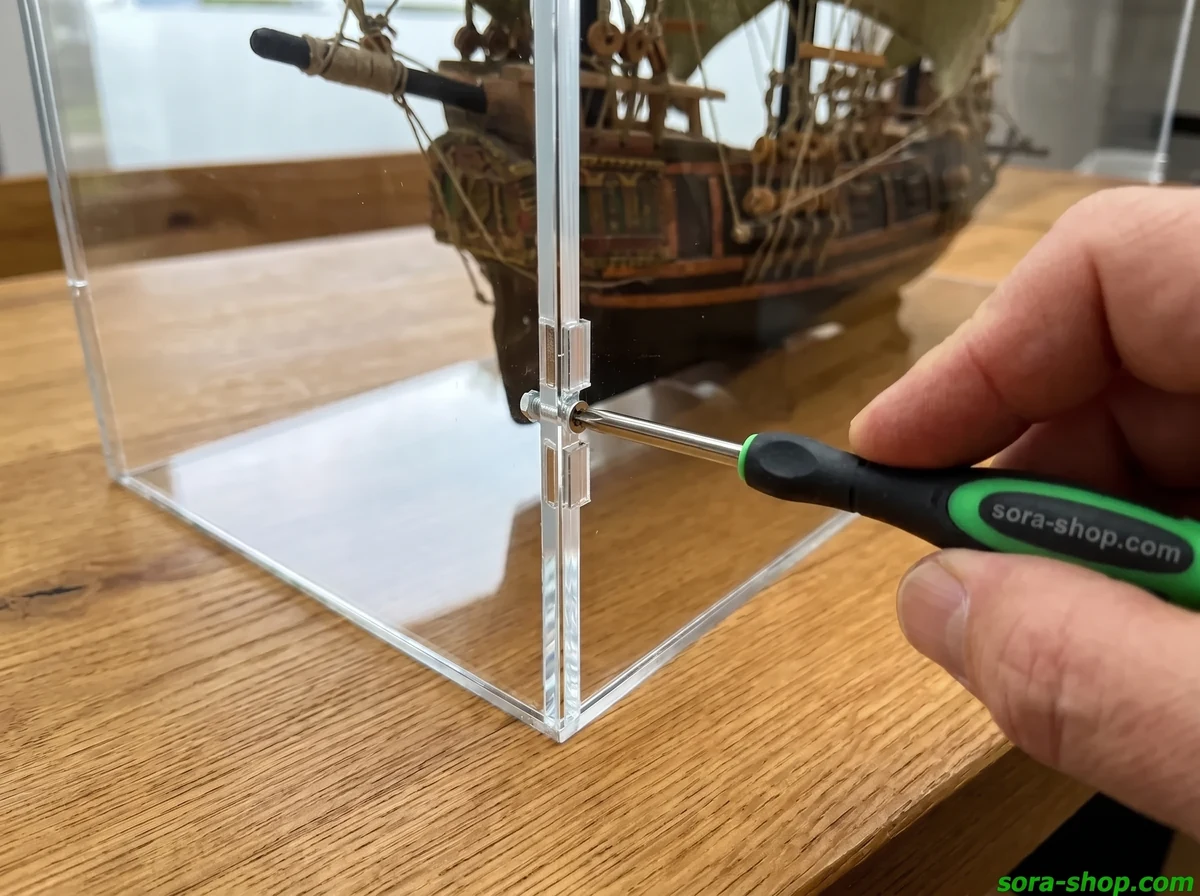
Close-up of the Sora plug-and-screw system with small screws in the corner of the acrylic glass

Material and quality

High-grade PMMA acrylic glass of industrial quality — crystal clear, lightfast, lighter and more impact-resistant than glass.

4 mm stringers & step surfaces
3 mm step fronts
> 92 % light transmission
approx. 8 working days delivery time

Lightfastness, UV behaviour and care

The acrylic glass we use does not yellow and does not become brittle even after years in direct sunlight. Important: the acrylic glass is UV-stable but offers no UV protection for the objects on display — in a shop window, printed packaging still fades.

Cleaning: a soft cloth, lukewarm water and a little washing-up liquid — or an acrylic glass cleaner. No glass cleaners containing alcohol or ammonia, and no abrasives.

What you should know after delivery

Don’t be alarmed: the protective film

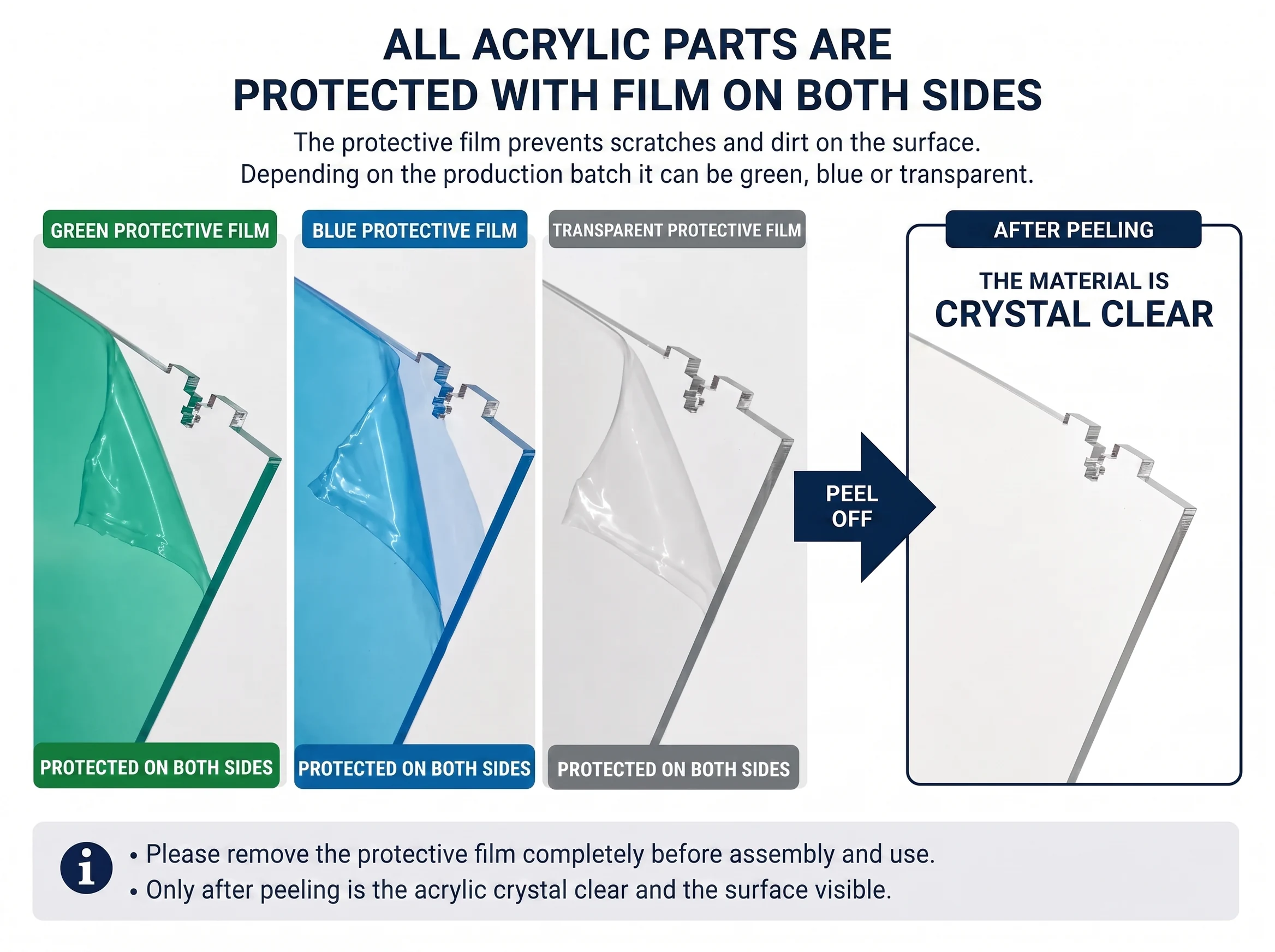
When your parcel arrives, the acrylic parts will probably look blue, green, white or even scratched. That is the protective film covering every part on both sides to prevent scratches during production and shipping (reflective fronts are filmed on the front only).

Simply lift the film at one corner with your fingernail — acrylic cannot be scratched by a fingernail. On a staircase with many steps that adds up to quite a few parts: allow yourself a few minutes.

Protective film being peeled off an acrylic panel, crystal-clear acrylic visible underneath

Assembly instructions

How to assemble your display staircase in a few minutes.

Assembly instructions (PDF) →

Made to measure – no right of withdrawal

This item is manufactured individually for you, to the dimensions and options you choose, only after you have placed your order. Under section 312g(2) no. 1 of the German Civil Code (BGB), such custom-made items are excluded from the statutory right of withdrawal; exchange or return is therefore not possible. Please check your measurements carefully before ordering. Your statutory warranty rights in the event of manufacturing faults or transport damage are not affected – see our Right of Withdrawal page for details.

Not sure about the number of steps? The Sora adviser can help.

Tell it what is going on the staircase and how much space you have — it will work out a suitable division of steps for you. The adviser sits in the search field at the very top of this page and answers straight away.

Frequently asked questions about the made-to-measure display staircase

Do I specify the dimensions of the individual step?

No. You specify the overall dimensions of the staircase — width, depth, height — plus the number of steps. From these the configurator works out the step height (height ÷ steps) and the step depth (depth ÷ steps − 1 mm) and shows both values live before you order.

How many steps make sense?

That depends on your objects, not on looks. Rule of thumb: the step height should be about one third to one half of the object height so that the back row stays clearly visible. The step depth should be 1–2 cm greater than the deepest object. Try two or three different numbers of steps in the configurator — the values shown make the decision easy.

Why does the configurator report “step depth too small”?

Because the overall depth and the number of steps would produce a step surface of less than 4 cm — and our plug-and-screw system cannot be made that narrow: the step surface and the step front are plugged into one another and screwed together, and for that the surface needs a minimum depth. Choose fewer steps, or make the staircase deeper. The same check applies to the step height: at least 3 cm, at most 50 cm.

What are the step fronts, and can I leave them out?

The front is the vertical surface between two steps — and at the same time the support beam on which the step surface above it rests. It is therefore structurally part of the staircase and cannot be deselected; what you do decide is the material: transparent (standard), black or reflective. Transparent makes the staircase look almost invisible, black provides contrast, and reflective makes the collection look larger.

How large can the staircase be?

Width 12–100 cm, depth 5–100 cm, height 4–100 cm, up to 100 steps. In addition: only one of depth and height may exceed 50 cm. For larger or multi-part staircases, send us the dimensions using the contact form — if it is feasible, you will receive a quotation without obligation.

Will a wide staircase take the weight?

Yes — from 30 cm, 60 cm and 80 cm of width we automatically add one further support stringer in the middle each time, so that the step surfaces do not have to span unsupported. That is already included in the price shown; you do not have to set anything.

Will a display case fit over the staircase?

Yes, that is a very common combination. Configure the staircase first and then order the made-to-measure acrylic display case with about 1 cm of clearance in width and depth. For the height, add the staircase height plus the height of the topmost object plus 1 cm — and remember that a base reduces the usable inside height by 4 mm.

How is the staircase constructed?

From three kinds of component: the side stringers (on wide staircases centre stringers are added), the step surfaces and the step fronts. Each surface rests on its front via a small plug-together joint and projects slightly beyond it — so the front carries part of the load. Everything is plugged together and screwed, nothing is glued.

One step has broken — do I have to buy everything again?

No. Because nothing is glued, every single part can be reordered — step surface, front or stringer. You will find the spare parts in the spare parts configurator.

Only one part broken?

Thanks to the plug-together system every component can be reordered individually — all you need are the dimensions of your staircase.

To the spare parts →

Your price in 3 minutes

Enter the dimensions, choose the number of steps, see the step dimensions and the price in real time.
Manufactured in a German manufactory, delivery in approx. 8 working days.

Configure now →