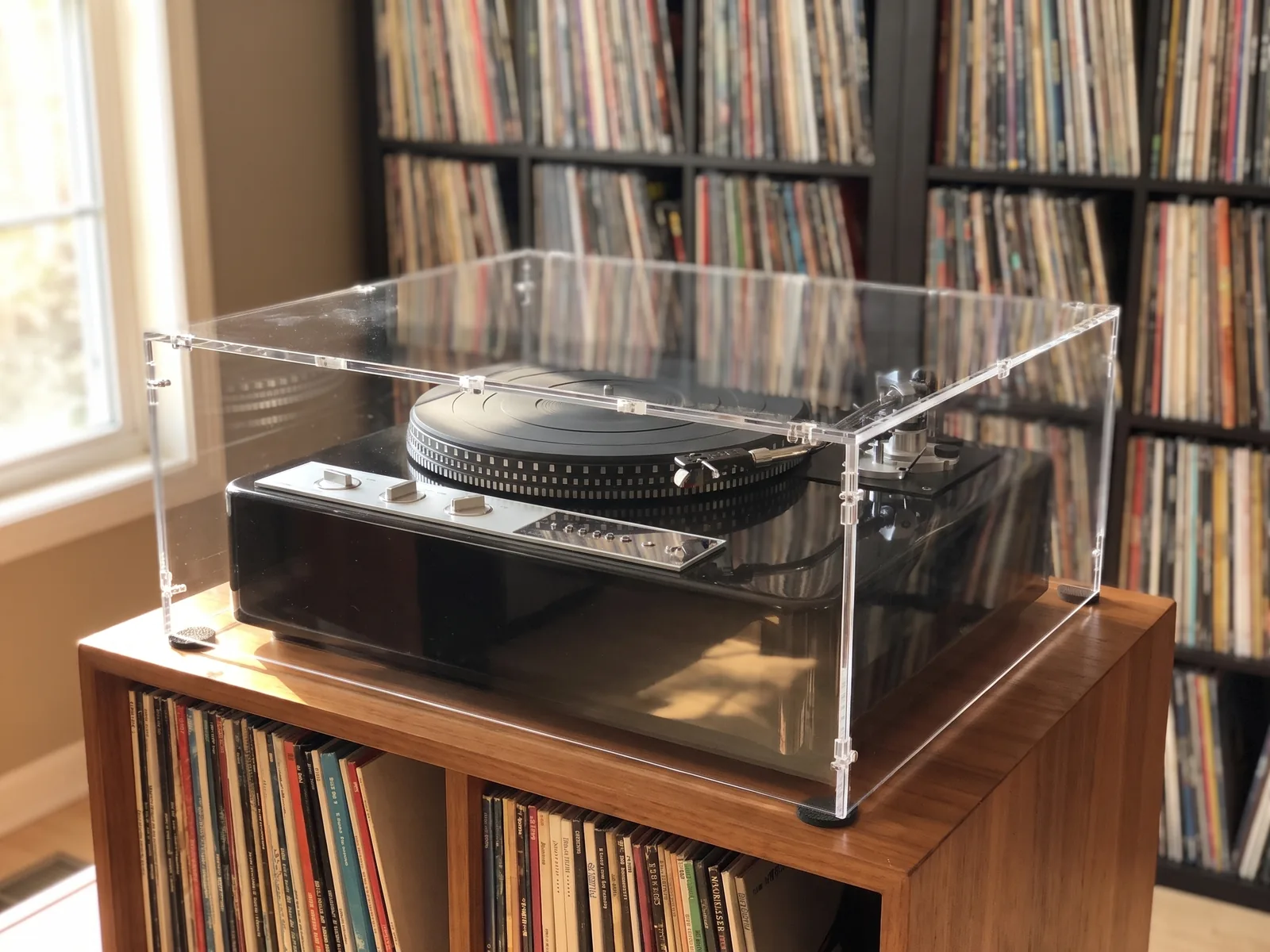
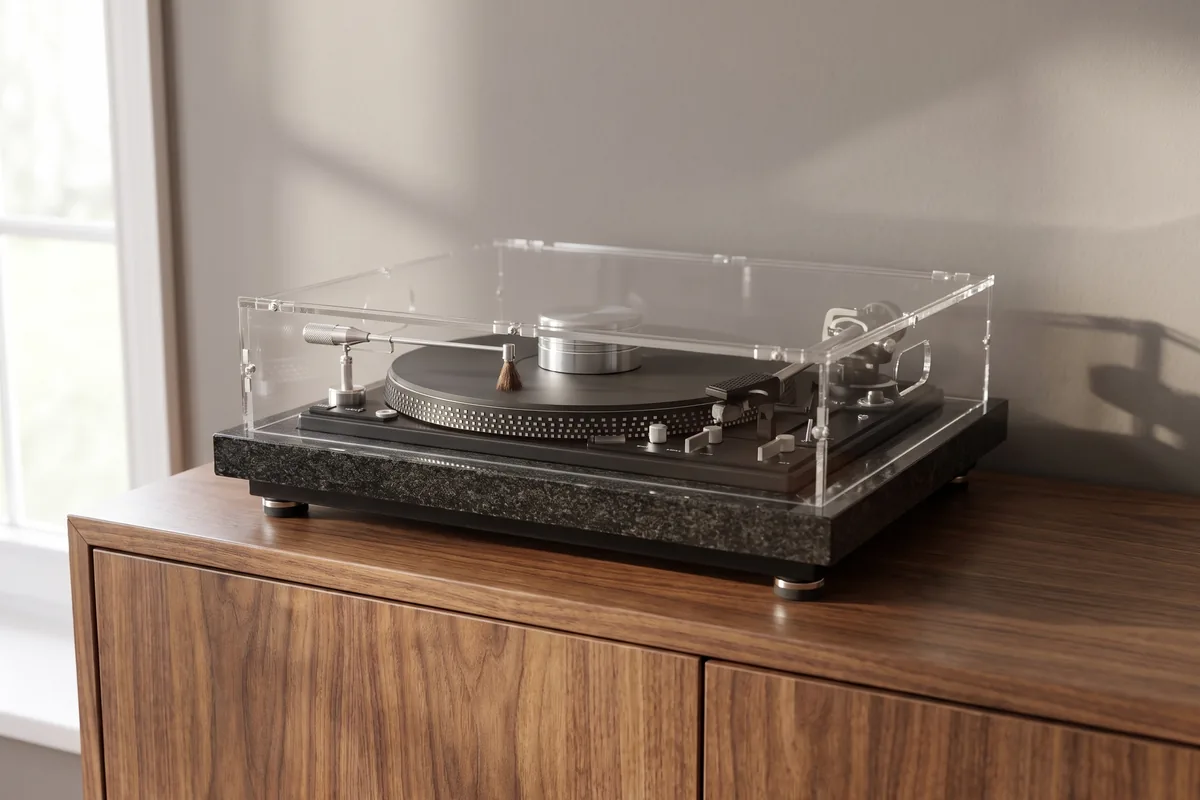
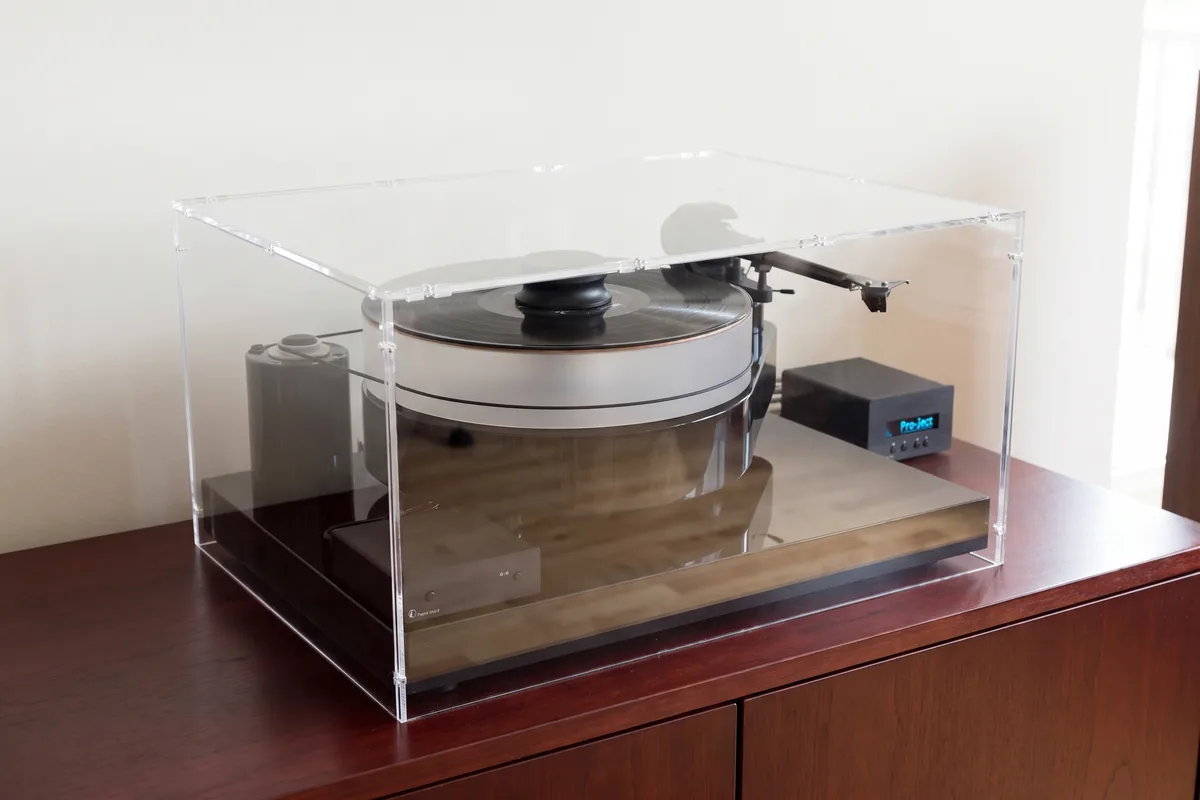
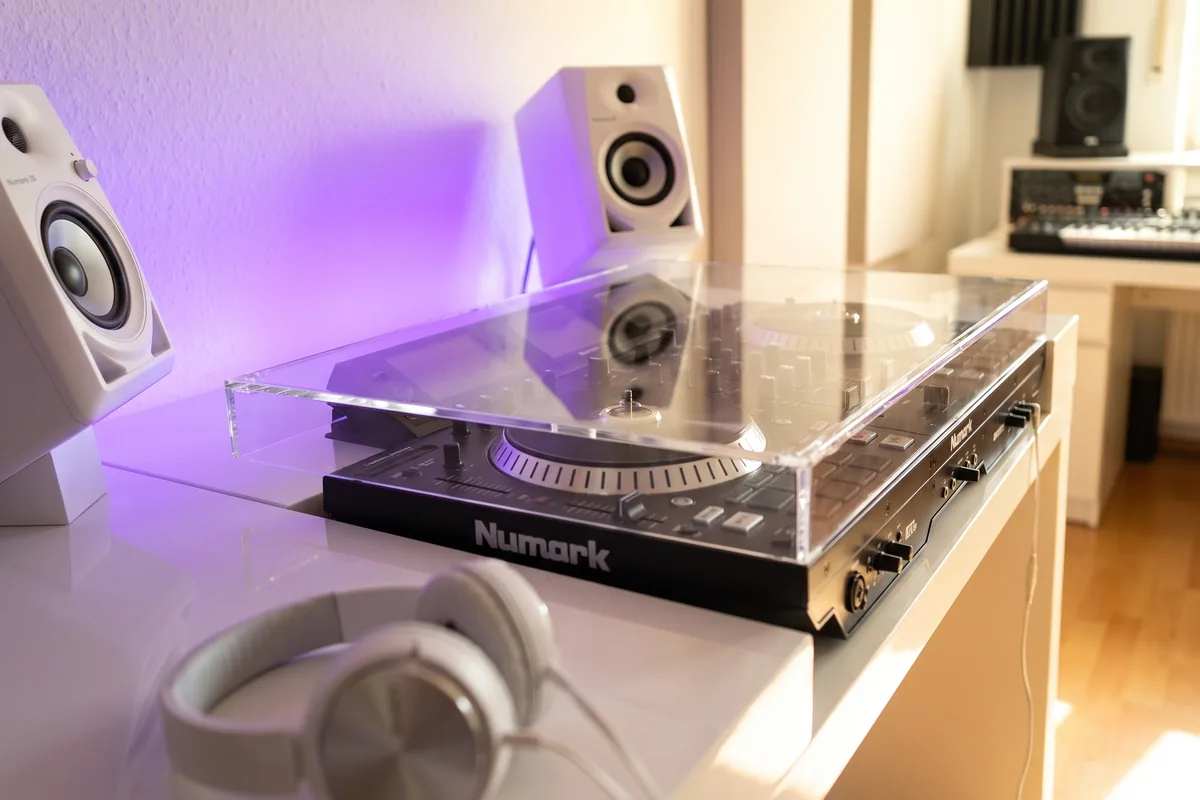
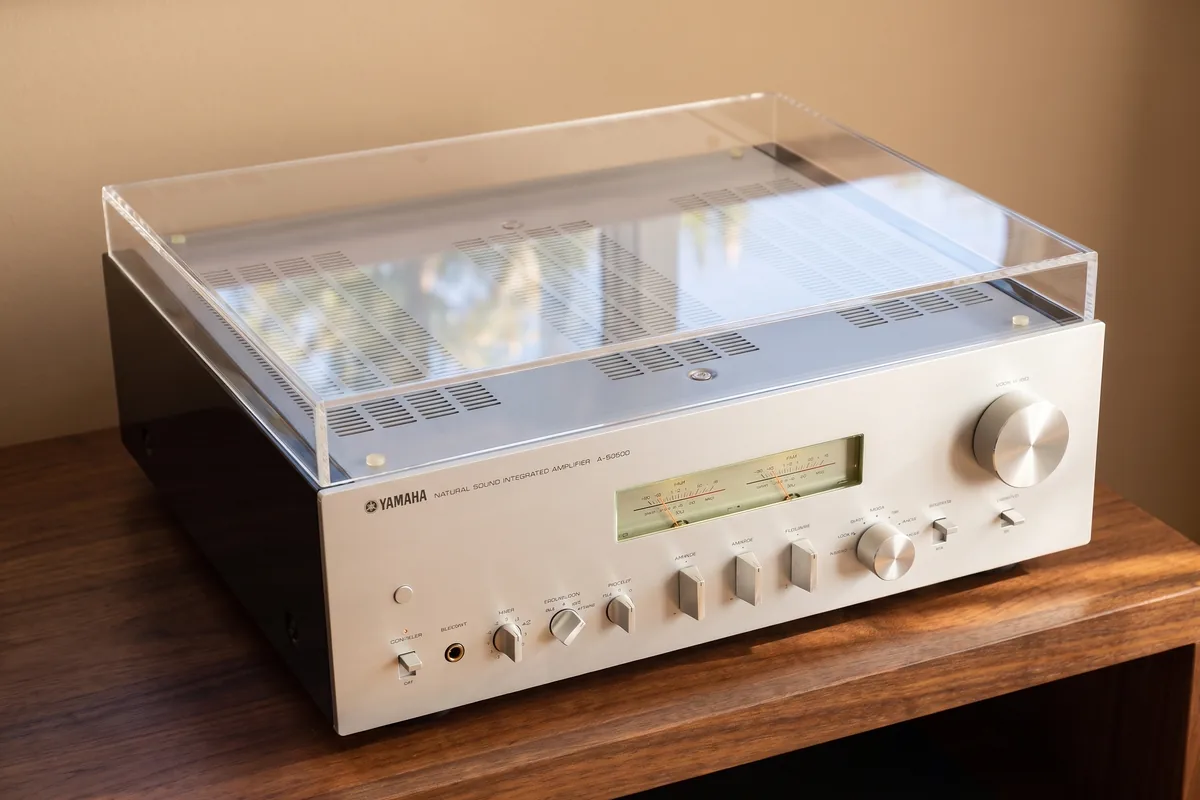
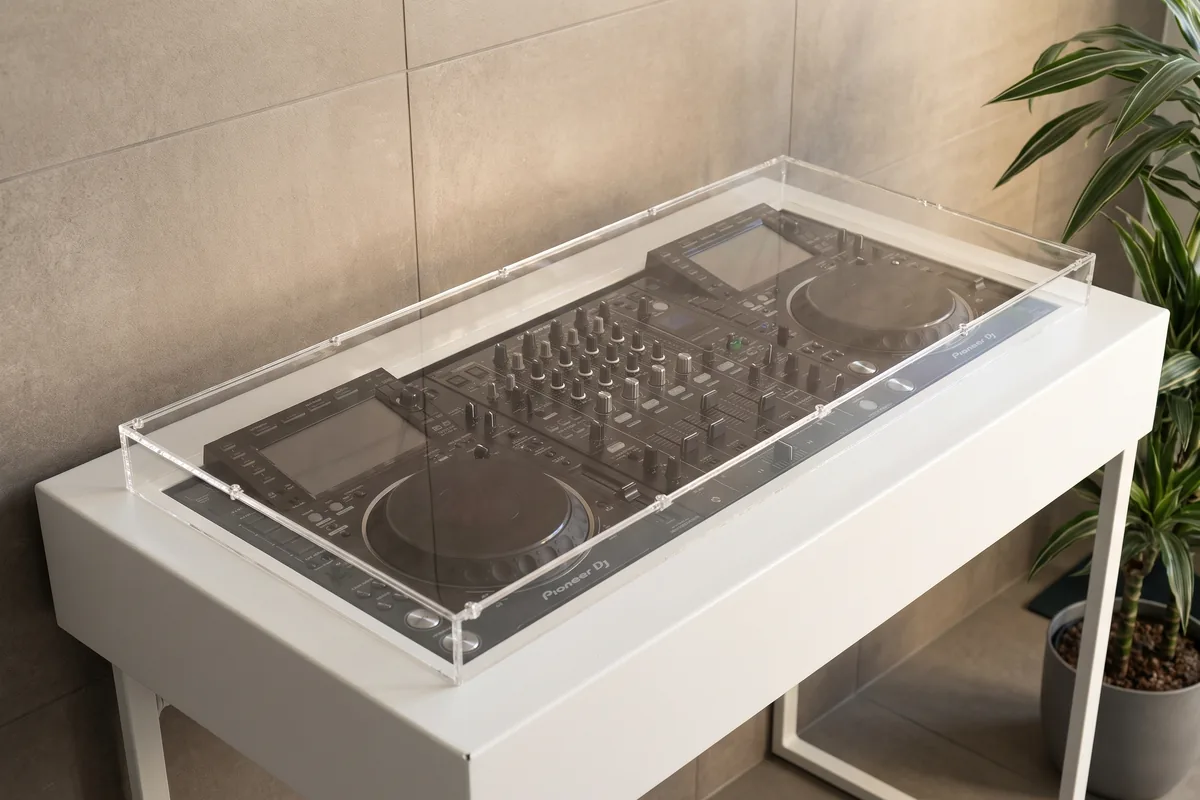
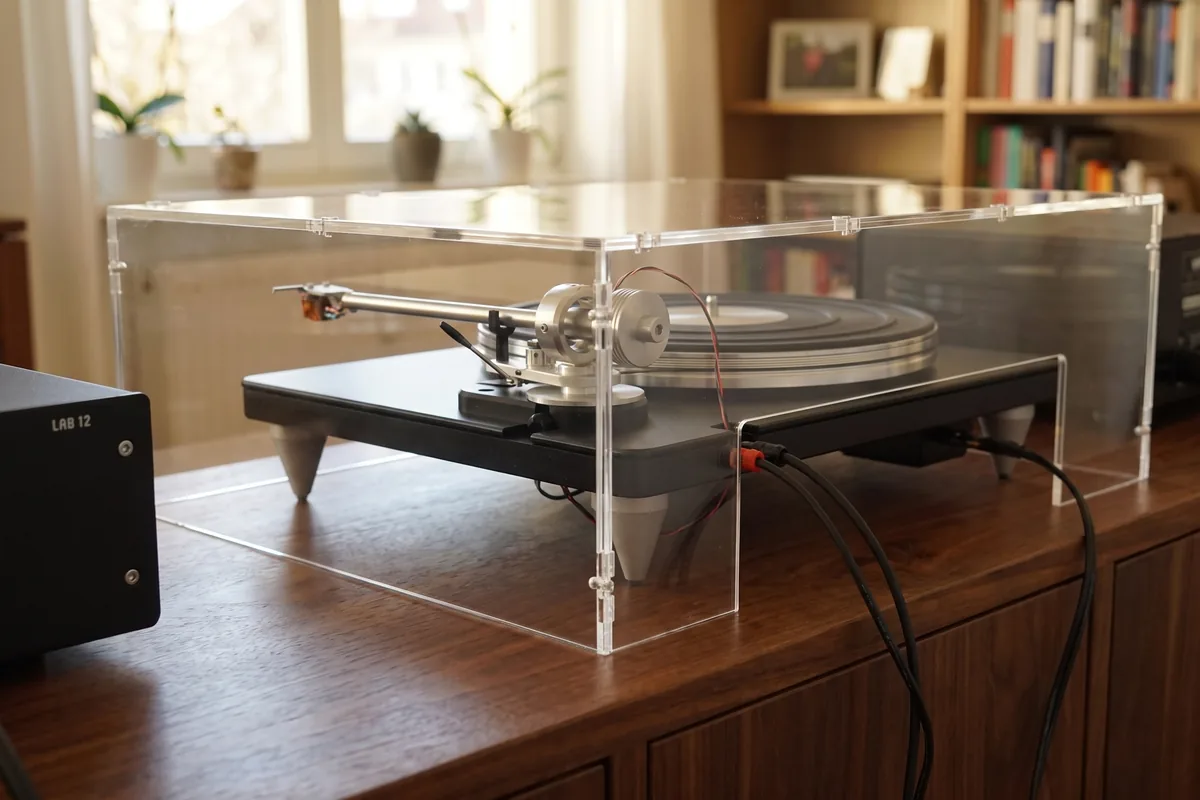
The original cover is yellowed, cracked or long since lost – and for older equipment there is no replacement to be had. Sora manufactures your turntable cover to measure in clear acrylic glass, on request with a cable cut-out in the back panel. And because the principle is the same: covers for amplifiers, tape decks and other hi-fi equipment too.
Measure the equipment · enter the inside dimensions · choose the cable cut-out · order — in about 3 minutes
Turntable covers are wearing parts: they are handled, opened and set down every day. After decades the hinge points are torn out, the edges are chipped or the material has yellowed and gone dull.
For most equipment there are no original covers left, and where there are, they cost more than the equipment itself. New manufacture to measure solves the problem for good: you measure your equipment, we make the cover to fit – in clear PMMA acrylic glass that does not yellow and does not become brittle.
The practical difference to the original cover: ours is a removable dust cover, not a hinged lid. It is placed over the equipment and lifted off to put a record on. That has an acoustic side effect many vinyl listeners prefer anyway: with the cover off during play there is no resonating surface above the tonearm.
So that mains and signal cables are not in the way, the configurator offers an optional cable cut-out in the back panel – the cover then sits neatly in place even while the equipment stays connected.
Six typical cases from everyday hi-fi life.
The classic: the equipment works perfectly, only the cover is clouded, cracked or yellow. A new cover made to measure makes the turntable look complete again.
Many modern decks are delivered with no dust protection at all. A cover made to measure protects the platter, tonearm and cartridge while the deck is idle.
Direct drive decks in the 45 cm format often stand out in the open – and gather dust accordingly. A removable cover is put away faster than a slip cover.
Vintage components with wooden cheeks and exposed controls gather dust on the shelf. A low cover made to measure protects them without cluttering the look.
Faders and potentiometers are the parts most sensitive to dust in any studio. A precisely fitting cover can save you cleaning or replacing the controls.
So that the cover sits flat even with the equipment connected, a cable cut-out can be configured in the back panel – you specify its position and size.
Guide values by type of equipment – please always measure your own unit, as the dimensions differ even within a model range. What you measure is the footprint including the feet, and the height up to the highest point (usually the tonearm base or the counterweight).
| Type of equipment | Typical footprint | Suggested inside dimensions (W × D × H) | Straight there |
|---|---|---|---|
| Entry-level turntable (belt drive) | approx. 42 × 32 cm | approx. 44 × 35 × 16 cm | Configure a cover |
| Direct drive turntable (DJ format) | approx. 45,3 × 36 cm | approx. 47 × 38 × 18 cm | Configure a cover |
| Subchassis deck (classic) | approx. 44 × 36 cm | approx. 46 × 39 × 20 cm | Configure a cover |
| Deck with external power supply / high tonearm base | approx. 46 × 38 cm | approx. 49 × 41 × 22 cm | Configure a cover |
| Integrated amplifier / receiver (43 cm standard) | approx. 43 × 35 cm | approx. 45 × 37 × 17 cm | Made to Measure Display Case |
| CD player / tape deck | approx. 43 × 30 cm | approx. 45 × 32 × 13 cm | Made to Measure Display Case |
| Music centre / portable record player | approx. 35 × 30 cm | approx. 37 × 32 × 20 cm | Made to Measure Display Case |
| DJ mixer (2–4 channels) | approx. 32 × 40 cm | approx. 34 × 42 × 12 cm | Made to Measure Display Case |
| Valve amplifier | approx. 35 × 30 cm | only while switched off – see the note on heat below | Made to Measure Display Case |
Important: these are guide values by type of equipment, not manufacturer
specifications – models from the same range differ by centimetres. Measure your own unit,
including the feet, the counterweight and any attached tonearm base.
Tip: tap the link in the last column to open the matching configurator.
The material thickness is always the same: 4 mm clear acrylic glass, with
a back panel in black or reflective (mirror) acrylic in 3 mm.
New decks, reissues of classics and equipment supplied without dust protection. Where the dimensions are known, we suggest the matching inside dimensions straight away.
The configurator guides you step by step – including the optional cable cut-out.
Width and depth of the footprint including the feet and any protruding controls, height up to the highest point (usually the counterweight or the tonearm lift).
Do not forget the counterweight!Enter the measurements plus a little clearance as inside dimensions – that is the space for your equipment.
Inside dimensions, not outside dimensions!If the cover is to sit in place while the equipment is connected, specify the position and size of the cut-out in the back panel.
Price in real time. Delivery in approx. 8 working days – assembly in a few minutes.
The highest point is rarely the platter
With turntables the height is almost always underestimated: what counts are the counterweight, the tonearm lift, the cover hinges (if they stay in place) and the plinth – not the platter. Measure at rest with a record on the platter and you are on the safe side. The dimensions given are always inside dimensions; the outside dimensions are slightly larger because of the material thickness and the slot-together system:
outside width = inside width + 14 mm outside depth = inside depth + 8 mm outside height (without base) = inside height + 7 mmTip: allow 1–2 cm of clearance all round. Otherwise, sooner or later, you will catch the counterweight when setting the cover down – and that is the part you least want to knock.
Amplifiers, receivers and valve equipment in particular give off considerable heat in operation. Under a closed acrylic cover that heat builds up, so take the cover off before switching on. With valve amplifiers this applies without exception: the cover is dust protection for the time the equipment is switched off.
We manufacture removable dust covers, not hinged lids – the slot-and-screw system is designed for straight edges. In practice that is no disadvantage for most users: the cover is lifted off to put a record on anyway, and with no cover above the tonearm there is no resonating surface during play.
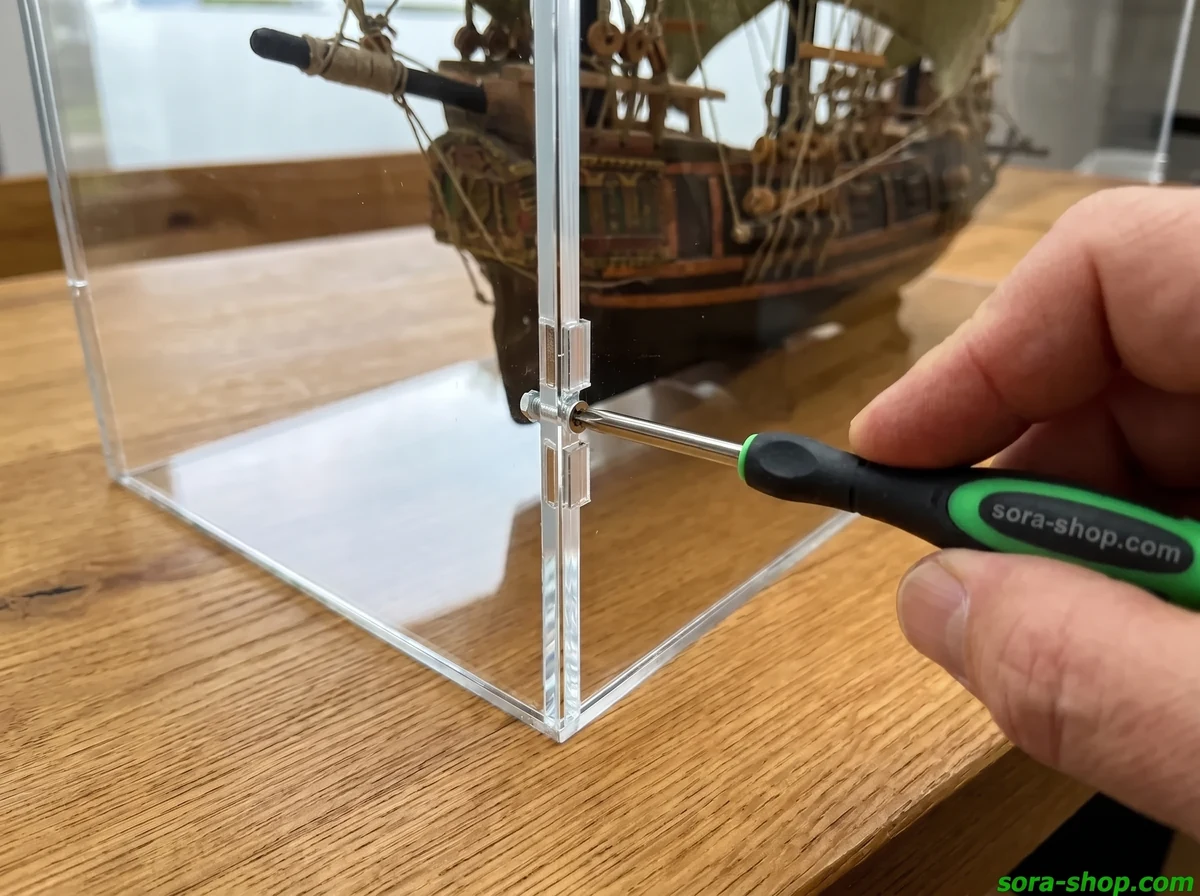
If only one panel of a Sora cover is scratched or broken, order the individual part instead of a complete cover – through the spare part configurators. That is one of the reasons why we screw rather than glue.
We work exclusively with high-grade PMMA acrylic glass of industrial quality – crystal clear, lightfast and in the lasting Sora quality.
The acrylic glass we use does not yellow and does not become brittle even after years in direct sunlight. Important: the acrylic glass itself is UV-stable, but it offers no UV protection for the collectable on display. With hi-fi equipment, fading affects mainly wooden plinths, printed dials and plastic covers – a turntable right next to a window ages visibly faster.
We do not glue and we do not cast in one piece: the cover is delivered as a construction kit with small screws and nuts. With an equipment cover that means above all that it arrives undamaged – a glued cover of this size rarely survives parcel shipping – and that a scratched front panel can be replaced on its own.
By the way: our plug-and-screw system is no passing fashion – we developed it ourselves more than 20 years ago and had it officially registered as a utility model. View the original document as a PDF ↗
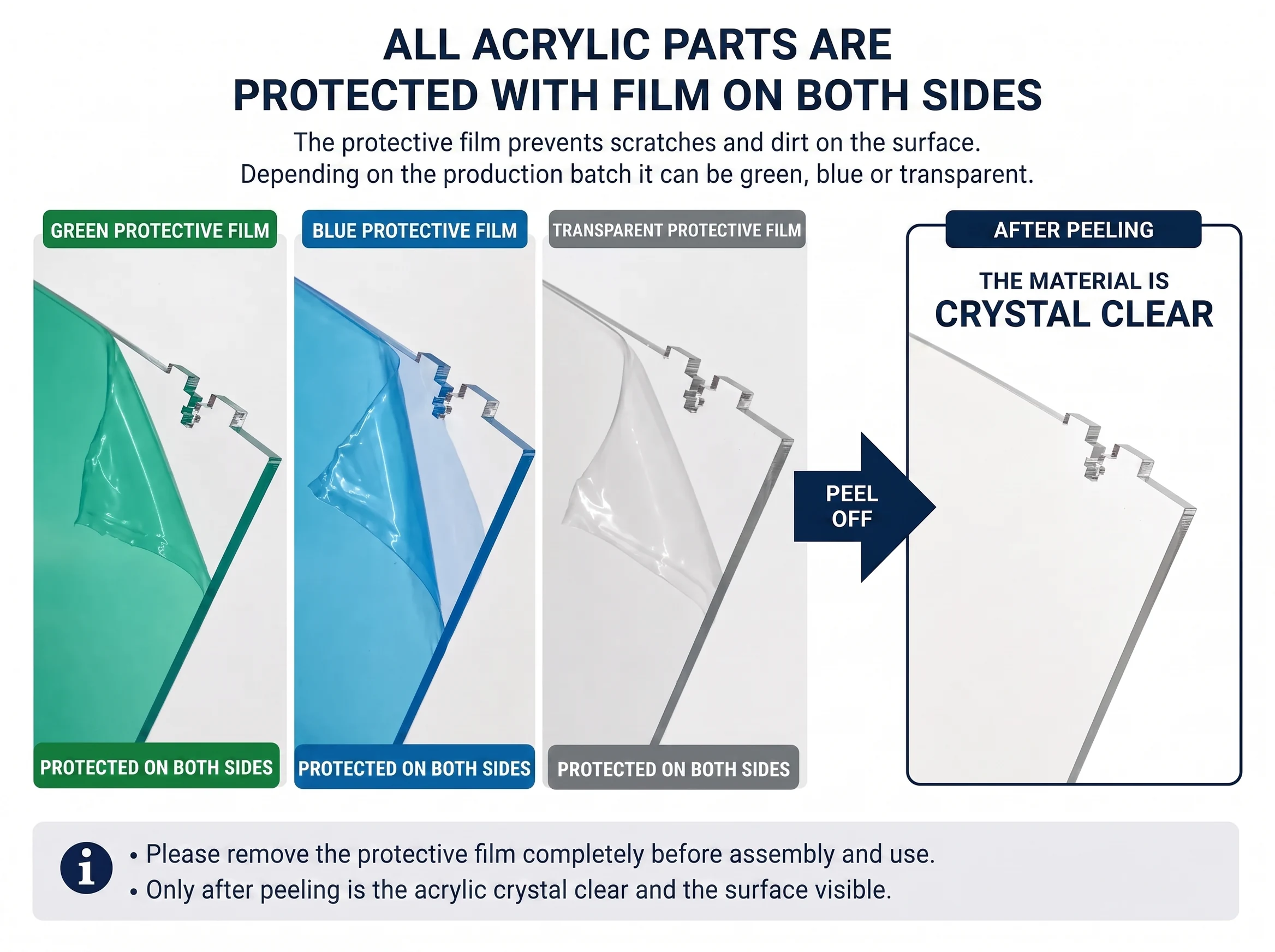
When your parcel arrives, the acrylic parts will probably look blue, green, white or even scratched. That is the protective film covering every part on both sides to prevent scratches during production and shipping (reflective elements are filmed on the front only).
Simply lift the film at one corner with your fingernail – acrylic cannot be scratched by a fingernail. Underneath, crystal-clear, flawless acrylic glass comes to light.
For other equipment, spare parts and the record collection itself.
For amplifiers, tape decks, CD players, mixers and everything else in the rack – width, depth and height freely selectable.
Configure a display case ↗Rectangular sheets in the size you want – as an equipment base, an intermediate shelf in the rack or a cover, in clear, black or reflective acrylic.
Configure a cut to size sheet ↗The collection belongs with the turntable: acrylic racks for LPs, CDs and singles are available ready-made or to measure.
To the Media & Racks collector's world ↗Only one panel broken or scratched? Individual parts can be reordered separately instead of replacing the whole cover.
Configure spare parts ↗No. We manufacture removable dust covers that are placed over the equipment, not hinged covers. To put a record on, you lift the cover off. Many vinyl listeners prefer that anyway, because there is then no resonating surface above the tonearm during play.
Width and depth of the footprint including the feet and any protruding controls; the height up to the highest point, which is usually the counterweight of the tonearm, not the platter. Measure at rest with a record on the platter and add 1 to 2 cm of clearance.
A recess in the back panel through which mains and signal cables are led out to the rear. The cover then sits flat even while the equipment stays connected. You specify the position and size in the turntable configurator; without a cut-out the back panel stays closed.
With a turntable the cover comes off for play in any case. With amplifiers, receivers and above all valve equipment the rule is: fit the cover only while the equipment is switched off, as the waste heat builds up under a closed acrylic cover.
The PMMA acrylic glass we use does not yellow and does not become brittle, unlike many old original covers, which were made from other plastics. It does not, however, offer UV protection for the equipment underneath: wooden plinths and printed dials still fade in direct sunlight.
We manufacture to the dimensions you give us, not to model names. So this is not an original spare part but a made-to-measure item that fits exactly the values you have measured. That is why careful measuring matters more than the model designation.
Then you order just that individual part. All Sora covers are screwed rather than glued, and the spare part configurators supply the matching panel in your dimensions.
No renderings: this is how Sora covers look on real equipment. A selection from the photos our customers send us after delivery.
Enter the dimensions, see the price in real time, order – manufactured in Germany.
Delivery in approx. 8 working days, assembly in a few minutes.