Display cabinet
The classic: width 10–100 cm, height 15–100 cm, compartment depth 3–20 cm, up to 16 rows and 12 columns. Either the width or the height may exceed 50 cm.
Configure a display cabinet →One cabinet, many compartments: you set the outside width, compartment depth and outside height and divide it into individual compartments using rows and columns — for model cars, minifigures, miniatures or your CD collection. With a front panel it becomes a closed display cabinet, without a front panel an open rack. Assembly needs no tools, and hanging eyelets for the wall are included as standard. Three minutes in the configurator, delivery in about 8 working days.
Enter your dimensions · choose compartments and columns · order — in about 3 minutes
All four are based on the same construction and the same price formula — they differ only in the permitted dimensions and the additional fields.
The classic: width 10–100 cm, height 15–100 cm, compartment depth 3–20 cm, up to 16 rows and 12 columns. Either the width or the height may exceed 50 cm.
Configure a display cabinet →For when both the width and the height exceed 50 cm. There is a surcharge for the reinforced bulky-goods shipping. Shipping to delivery addresses in Germany only.
Configure an oversize cabinet →The same manufacture, tailored to media collections: the default is a compartment depth of 14 cm, a black back panel and an open rack without a front panel.
Configure a made-to-measure rack →Works out automatically from your compartment width how many balls fit in each compartment — or you can specify the number per compartment yourself.
Configure a golf ball display cabinet →Here the display cabinet deliberately differs from our display cases — which is why it comes right at the top: you give the width and the height as the outside dimensions of the cabinet, but the depth as the inside dimension of the compartments.
Why is that? The width and the height decide whether the cabinet fits on the shelf, into the recess or on the wall — for that you need the outside dimensions. With the depth, all that matters is whether your objects fit inside. That is why the depth is the usable compartment depth.
Width = outside dimension of the cabinet Height = outside dimension of the cabinet Depth = inside compartment depthThe inside dimension of each individual compartment follows from the outside width and the number of columns, or the outside height and the number of rows — the wall thicknesses and intermediate shelves are deducted. The configurator works this out live; here is the formula:
34 mm is the deduction for the two outer walls including tolerance, and 4 mm for each dividing wall or intermediate shelf. Every individual compartment must remain at least 3,5 × 3,5 cm in size.
| Outside dimensions (W × D × H) | Layout | Inside compartment size (W × H) | Suits e. g. |
|---|---|---|---|
| 55 × 7 × 45 cm | 4 columns × 3 rows = 12 compartments | 12,4 × 13,3 cm | Model cars 1:43, collectors’ figures |
| 40 × 5 × 40 cm | 4 columns × 5 rows = 20 compartments | 8,7 × 6,8 cm | Minifigures, thimbles, pins |
| 60 × 10 × 30 cm | 3 columns × 2 rows = 6 compartments | 18,3 × 12,7 cm | Model cars 1:24, miniature bottles |
| 50 × 14 × 63,5 cm | 2 columns × 4 rows = 8 compartments | 22,7 × 14,5 cm | CDs standing upright (case 14,2 × 12,5 cm) |
Columns are not just about looks — the vertical dividing walls carry the shelves. Without that support, a long acrylic shelf will visibly sag over time.
That is why the configurator steps in: if a compartment is wider than 30 cm and the cabinet is deeper than 7 cm, you are asked to increase the number of columns. That is not red tape — it prevents sagging shelves a few years down the line.
A rule of thumb from 20 years of manufacturing: a single-column cabinet makes sense up to about 30 cm wide or up to 7 cm compartment depth. Anything beyond that is better divided into several columns — up to 12 are possible.
The cabinet arrives flat-packed — and is assembled differently from our display cases: nothing is screwed here. Shelves and dividing walls slot into one another, and the back panel is secured with small acrylic wedges. You will not need a screwdriver.
First the shelves are slid into the side walls. Then the back panel goes on: the tabs of the outer shelves reach through its slots, and a small wedge is pushed in crosswise to brace everything together.
The front panel is not screwed on but hooked into hooks on the vertical walls: place the slots over the hooks, lower the panel — done. To rearrange things you simply lift it off again.
No tools, no screws, nothing glued: the cabinet can be taken apart again at any time — for a house move, for cleaning or when the collection moves on. And every single part can be reordered: back panel (22211s), top / front panel (22211t), shelf with or without wedge holders (22211c/d), side wall with or without hooks (22211f/e) and the fixing wedges (22211x).
Every made-to-measure cabinet comes with two keyhole eyelets in the back panel as standard — the same proven shape as on our made-to-measure acrylic box. That applies to all four versions, so to the made-to-measure CD / DVD rack and the golf ball display cabinet as well, and also if the cabinet ends up standing on the sideboard after all. So you only decide once you are at home — there is nothing extra to order.
The screw head fits through the round opening; the cabinet is then lowered, the shank slides into the narrow neck and the head grips behind the back panel. Wall plugs and screws are not included — every wall needs different fixing material.
The two screws must sit exactly level and at the right spacing — which you can most easily take from the back panel supplied. When choosing your fixing material, think of the weight of the filled cabinet, not just of the empty one.
For very wide or well-filled cabinets we recommend standing them on a piece of furniture or providing an additional support — the eyelets carry the cabinet, but the load hangs on your wall. If in doubt, ask us beforehand: get in touch.
Two selection fields change the character of the piece completely.
| Option | Choice | Effect |
|---|---|---|
| Front panel 3 mm acrylic, hooked on |
with | A closed display cabinet: protects against dust and inquisitive fingers. The panel is hooked into hooks on the vertical walls and can be lifted off again without tools when you want to rearrange things. |
| without | An open rack: quick access, ideal for collections that are frequently added to or rearranged — and for CDs, DVDs and Blu-rays. | |
| Back panel | transparent | The standard. The wall or wallpaper stays visible and the cabinet looks light and unobtrusive. |
| black | A calm, high-contrast background — light-coloured objects and lettering stand out clearly. | |
| reflective (mirror) acrylic | The collection becomes visible twice over and the cabinet looks deeper and brighter. Popular for model cars and miniatures. |
Unlike our display cases, the back panel here is always part of the cabinet — including the transparent one. It stiffens the body and keeps the compartments aligned.
Six cases that come up again and again in our production — with the dimensions that have proved themselves for them.
The most common reason. For 1:87 (Wiking, Herpa) a compartment depth of 5–7 cm is enough, for 1:43 allow 7–10 cm, for 1:24 12–20 cm. A reflective back panel shows the driver’s side as well — a classic in collectors’ cabinets.
LEGO® minifigures, miniatures, blind-box figures: many rows, many columns, small compartments. Every figure gets its own compartment instead of vanishing in the row. The minimum is 3,5 × 3,5 cm per compartment.
Miniature spirit bottles, perfume samples, apothecary vials — here the compartment height is what counts. Measure the tallest bottle and add 1–2 cm of clearance so that it can be taken out comfortably.
Collections of small items benefit from many small compartments: up to 16 rows and 12 columns give almost 200 individual places. A black back panel makes metal and enamel glow.
There is a dedicated version for these: the made-to-measure CD / DVD rack — the same construction, but preconfigured for media collections. Details further down.
Merchandise on the counter, exhibits in the clubhouse, samples at the tradesman’s: acrylic is light, does not splinter and can be transported flat-packed — handy for changing exhibitions.
Technically the same cabinet — just with different default settings: compartment depth 14 cm, black back panel, no front panel. That way you can reach your discs without taking a panel off every time.
| Medium | Case (H × W) | required inside compartment height | Compartment depth |
|---|---|---|---|
| CD (jewel case) | 14,2 × 12,5 cm | from approx. 14,5 cm | 13–14 cm |
| DVD case | 19,0 × 13,5 cm | from approx. 19,5 cm | 14–15 cm |
| Blu-ray | 17,0 × 13,5 cm | from approx. 17,5 cm | 14–15 cm |
| Vinyl single (7") | 17,8 × 17,8 cm | from approx. 18,5 cm | 19–20 cm |
With an outside height of 63,5 cm and 4 rows the formula gives an inside compartment height of 14,5 cm — so CDs stand upright without jamming. DVDs need more clearance: an outside height of 65 cm over 3 rows gives 20,0 cm per compartment. What matters is always to compare the inside compartment height shown by the configurator with your case — not to divide the outside height by the number of rows.
On the width: a CD case is around 1 cm thick. A compartment with an inside width of 22,7 cm therefore holds a good 20 CDs — with 8 compartments that is around 170 discs. Better to plan in a little reserve, as collections are known to grow.
Then the oversize version applies — not for pricing reasons but because of the shipping: large cabinets need a specially reinforced package.
| Display cabinet | Oversize display cabinet | |
|---|---|---|
| Width / height | 10–100 cm / 15–100 cm | 10–100 cm / 15–100 cm |
| Combination rule | only one dimension above 50 cm | only one dimension above 75 cm |
| Compartment depth | 3–20 cm | 3–20 cm |
| Rows / columns | up to 16 / up to 12 | up to 16 / up to 12 |
| Shipping | as usual | Bulky-goods surcharge. Shipping to delivery addresses in Germany only. |
The oversize configurator checks this too: if your dimensions still fit the normal cabinet, it points that out and sends you back — so that you do not order a surcharge and a shipping restriction for no reason. We are happy to quote for even larger special orders manually: send us your dimensions via the contact form and you will receive a no-obligation quotation.
The cabinet arrives flat-packed as a construction kit — shelves and dividing walls are slotted together, the back panel is braced with acrylic wedges and the front panel is hooked in. Entirely without tools, in just a few minutes.
By the way: our plug-and-screw system is no passing fashion — we developed it ourselves more than 20 years ago and had it officially registered as a utility model. On the display cases screws secure the joint, on the cabinet the wedges do. View the original document as a PDF ↗
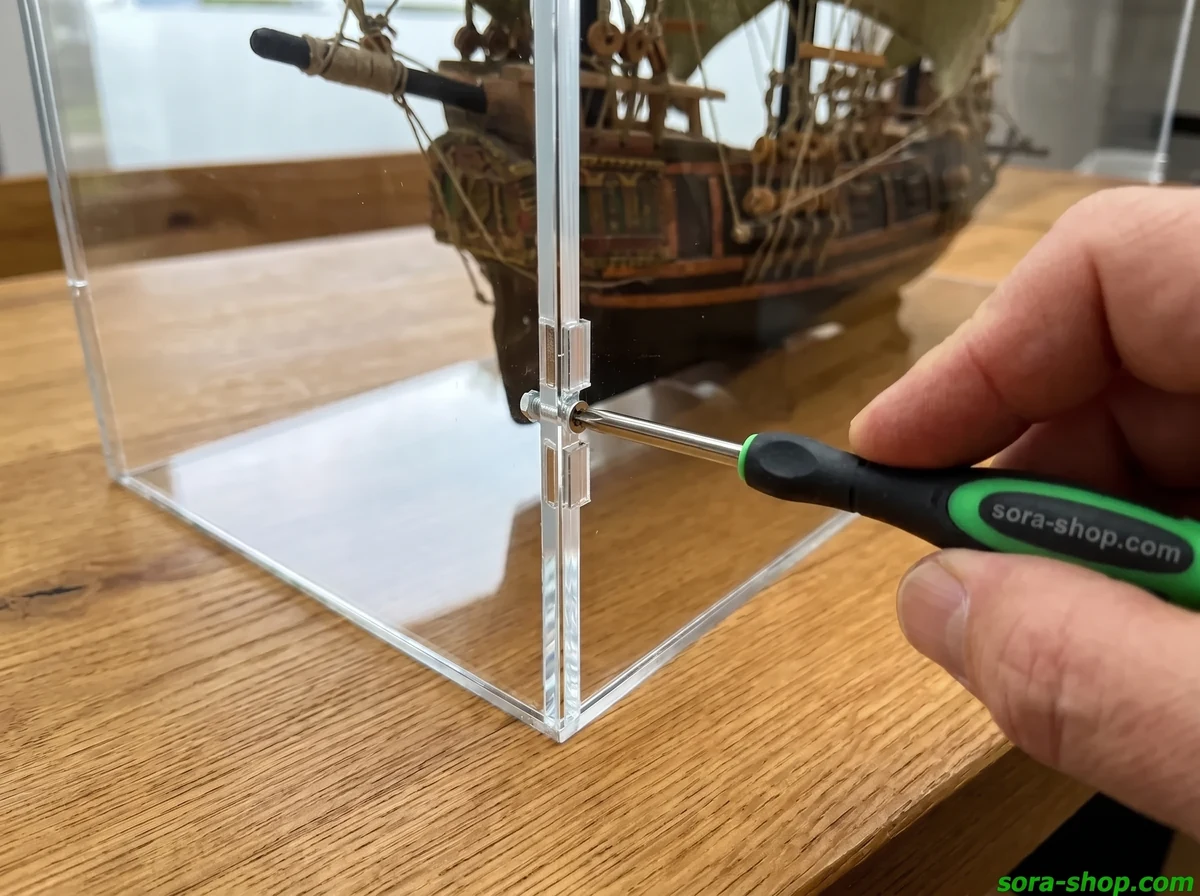
High-quality PMMA acrylic glass in industrial quality — crystal clear, lightfast, lighter and more impact-resistant than glass.
The acrylic glass we use does not yellow and will not become brittle even after years in direct sunlight. Important: the acrylic glass itself is UV-stable, but it offers no UV protection for the objects on display. Sensitive collectables — above all old packaging and printed boxes — should be kept out of direct sunlight.
Cleaning: a soft cloth, lukewarm water and a little washing-up liquid — or an acrylic glass cleaner. No glass cleaners containing alcohol or ammonia, and no abrasives.
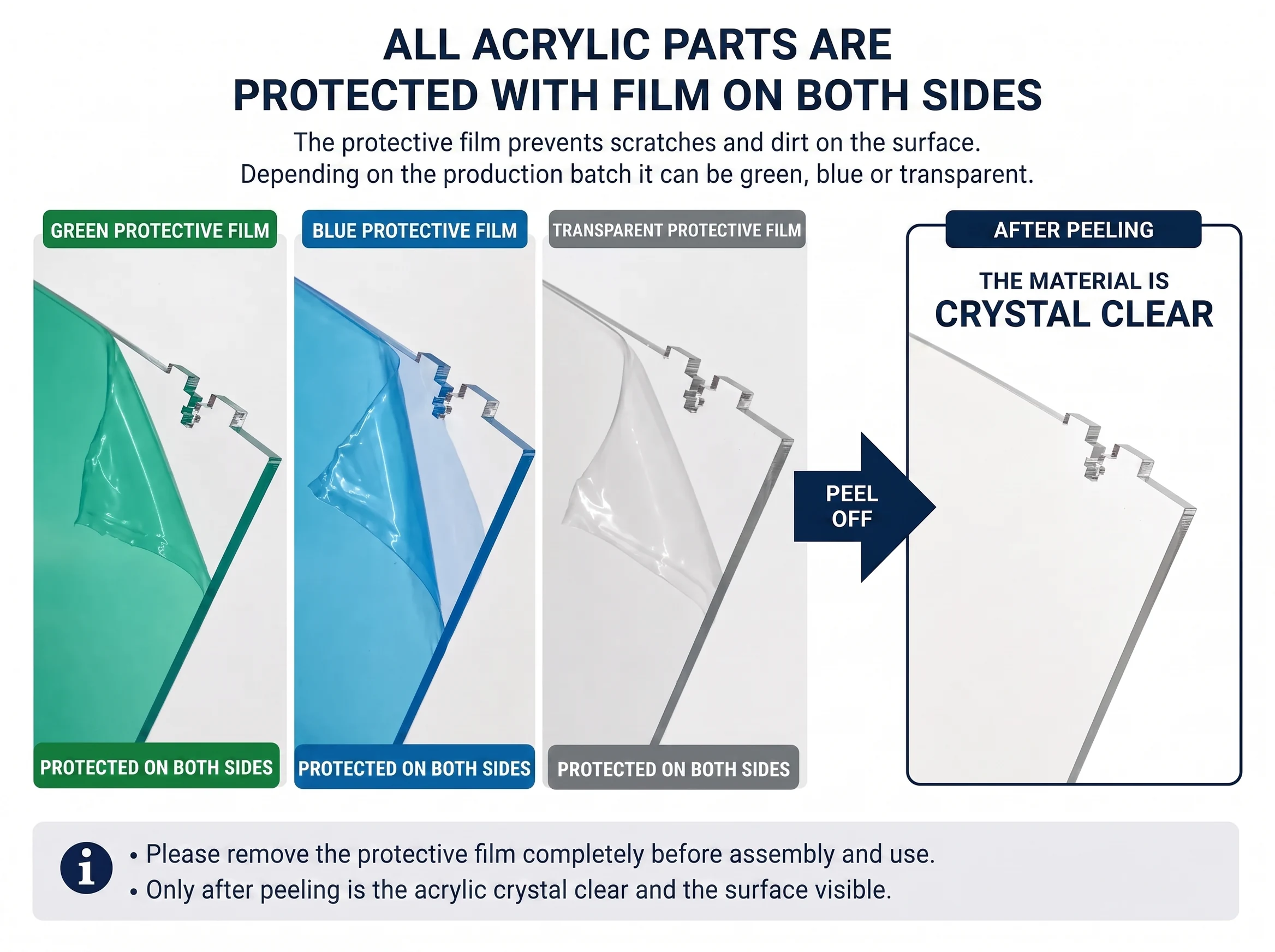
When your parcel arrives, the acrylic parts will probably look blue, green, white or even scratched. That is the protective film covering every part on both sides to prevent scratches during production and shipping (reflective elements are filmed on the front only).
Simply lift the film at one corner with your fingernail — acrylic cannot be scratched by a fingernail. With a cabinet that has many compartments, allow a few minutes more: every panel is filmed individually.
Depending on the version you ordered, one of the two instruction sheets applies:
Display cabinet / made-to-measure CD-DVD rack (PDF) → Golf ball display cabinet (PDF) →
This item is manufactured individually for you, to the dimensions and options you choose, only after you have placed your order. Under section 312g(2) no. 1 of the German Civil Code (BGB), such custom-made items are excluded from the statutory right of withdrawal; exchange or return is therefore not possible. Please check your measurements carefully before ordering. Your statutory warranty rights in the event of manufacturing faults or transport damage are not affected – see our Right of Withdrawal page for details.
Tell it what needs to go in and how much space you have — it will work out a sensible layout for you. The adviser sits in the search field right at the top of this page and answers straight away.
Outside dimensions — unlike our display cases. Only the depth is given as an inside dimension, namely as the usable compartment depth. The configurator works out the inside dimension of every individual compartment live and shows it before you order.
Inside compartment width (mm) = (outside width × 10 − 34 − (columns + 1) × 4) ÷ columns, and the inside compartment height accordingly with the rows. Example: 55 cm wide across 4 columns gives 12,4 cm per compartment; 45 cm high across 3 rows gives 13,3 cm. Every compartment must remain at least 3,5 × 3,5 cm in size.
Because acrylic shelves sag over time if they span too far unsupported. If a compartment is wider than 30 cm and the cabinet is deeper than 7 cm, the configurator asks for additional columns. The vertical dividing walls then support every shelf — so your cabinet stays straight even after years.
The construction and the price are identical — they differ in their default settings and additional fields. The made-to-measure CD / DVD rack starts with a compartment depth of 14 cm, a black back panel and no front panel. The golf ball display cabinet has an additional field for the number of balls per compartment and dimension limits typical of golf. Simply choose the version that suits your collection.
Only if you want a closed display cabinet. The 3 mm transparent front panel is hooked into hooks on the vertical walls and keeps dust and fingers out — to rearrange things you lift it off again without tools. For collections you reach into constantly — CDs, books, changing exhibits — the open version is more convenient. If you order “without front panel”, the side walls are made without hooks as well.
Up to 16 rows and 12 columns, so up to 192 individual compartments — provided every compartment remains at least 3,5 × 3,5 cm in size. The configurator checks this automatically.
Yes. Every display cabinet comes as standard with two keyhole eyelets near the top edge of the back panel — you do not need to order anything extra. The screw head fits through the round opening, then the cabinet is lowered and the shank slides into the narrow neck. Wall plugs and screws are not included, because every wall needs different fixing material — do bear in mind the weight of the filled cabinet. Details in our section on wall mounting.
No — unlike our display cases, the cabinet needs no tools at all. The shelves are slid into the side walls, the back panel is fitted and braced with small acrylic wedges; the front panel is hooked in. Nothing is glued, so everything can be taken apart again at any time. This applies to all made-to-measure cabinets without exception. Only with our ready-made modular cabinets from the standard range (the CD modular rack, the 1:18 modular cabinet or the H0 modular rack, for example) are individual parts additionally screwed together — and there the necessary material is included.
There is no need — with a front panel and a back panel the cabinet is already largely closed. If instead you want to present an open object dust-free, the made-to-measure acrylic display case is the right product.
No. Because nothing is glued, every single part can be reordered: back panel (22211s), top / front panel (22211t), shelf with wedge holders (22211c) or without (22211d), side wall with hooks (22211f) or without (22211e) and the fixing wedges (22211x). Have the details of your cabinet to hand — outside width, outside height, inside depth, columns, number of compartments and whether it has a front panel. You will find the spare parts in the spare parts configurator.
Thanks to the plug-and-screw system every component can be reordered individually — all you need are the dimensions of your cabinet.
Enter your dimensions, choose compartments and columns, see the compartment sizes and the price in real time.
Made in a German manufactory, delivered in about 8 working days.