Order a custom turntable cover — in 4 mm acrylic glass

Over 20 years of acrylic cover manufacture in Germany

The original cover is yellowed, cracked or long since lost — and for older equipment there is no replacement to be had. We make your turntable cover to the millimetre from your own measurements, on request with a cable cut-out in the back panel. In clear acrylic glass that does not yellow. Configurator in 3 minutes, delivery in approx. 8 working days.

Measure the equipment · enter the inside dimensions · choose the cable cut-out · order — in about 3 minutes

4 mm clear acrylic glass Cable cut-out freely configurable Manufactured in Germany
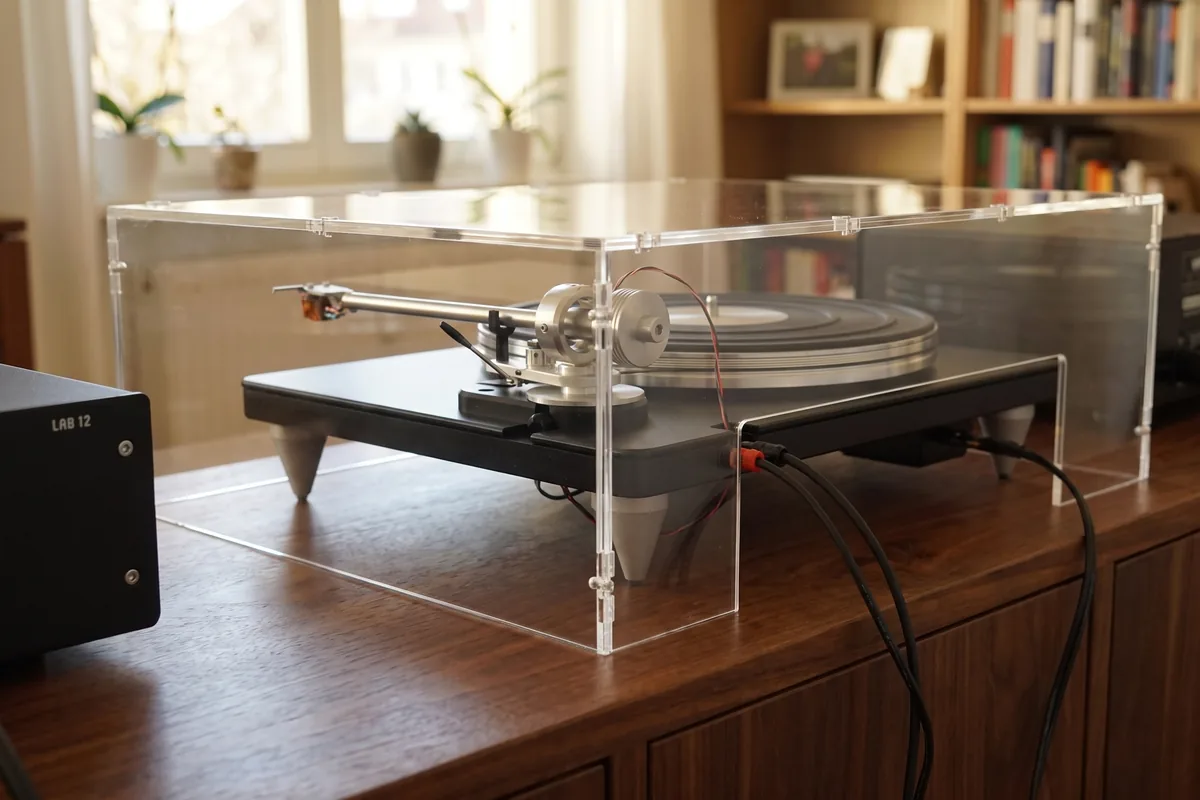
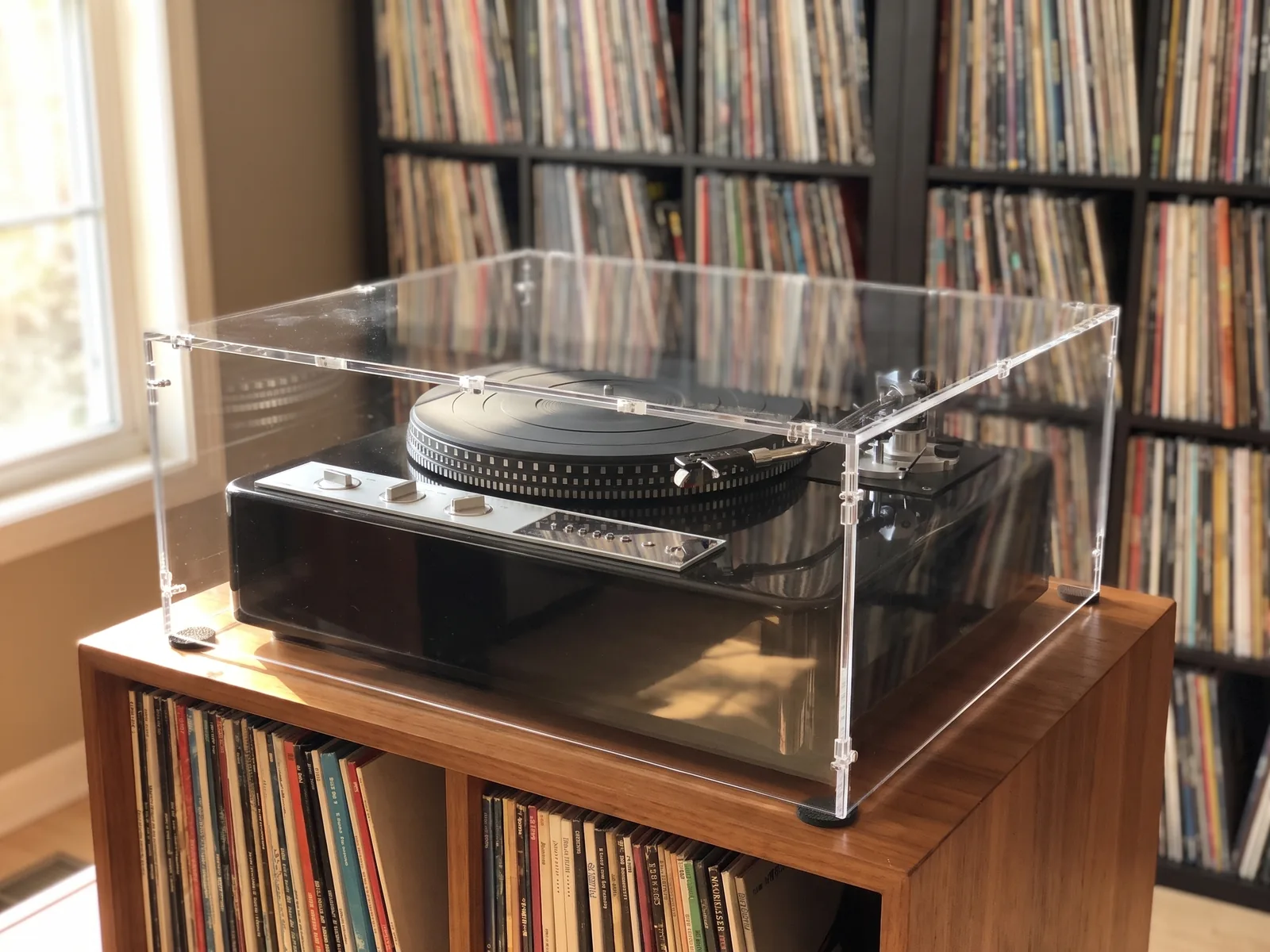
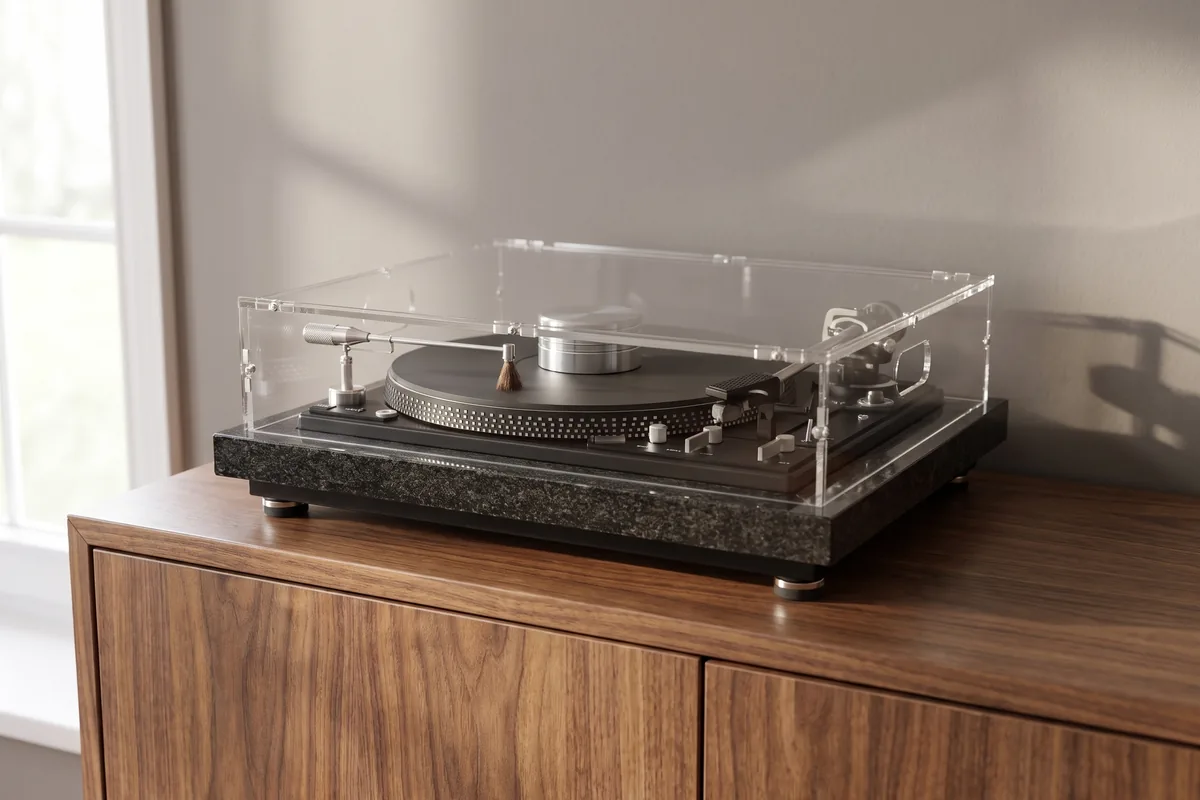
Turntable under a new made-to-measure acrylic cover on a sideboard
Classic turntable with a new clear acrylic cover instead of a yellowed original cover
Close-up of an acrylic cover with a cable cut-out in the back panel
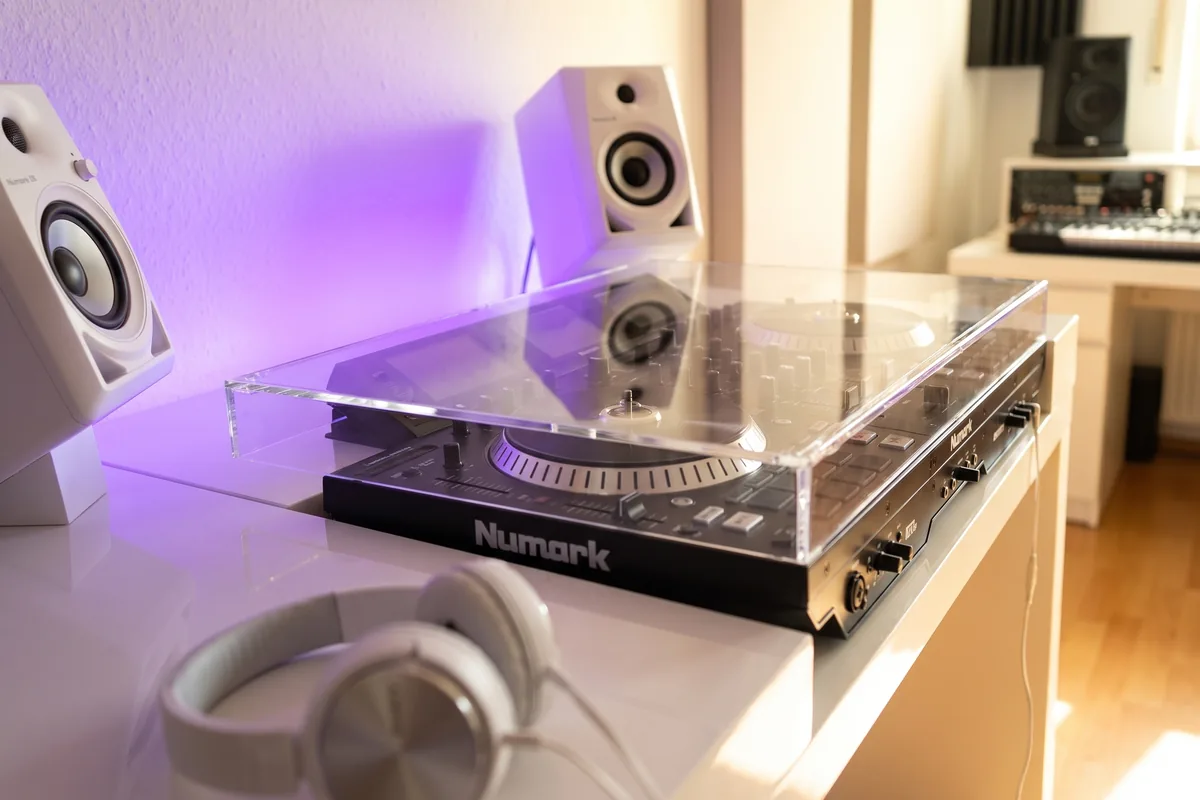
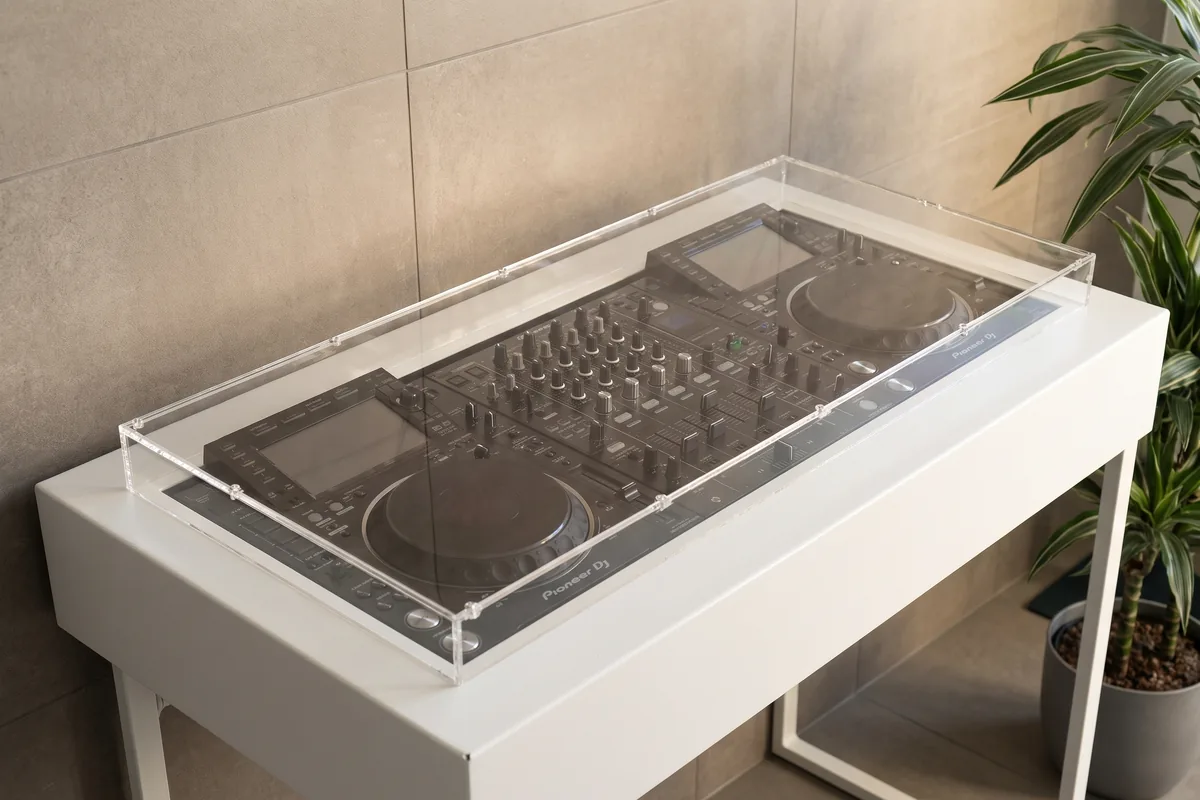
Direct-drive DJ turntable under a removable acrylic cover
…and many more examples further down ↓

What a made-to-measure turntable cover is used for

Six cases that come up in our workshop every day — from a seventies vinyl classic to a studio mixer.

Classic turntable with a new clear acrylic cover instead of a yellowed original cover on a sideboard

A replacement for the yellowed original cover

The deck works perfectly, only the cover is clouded, yellow or torn out at the hinge points. A new one made to measure makes the equipment look complete again — even when the manufacturer no longer supplies any parts.

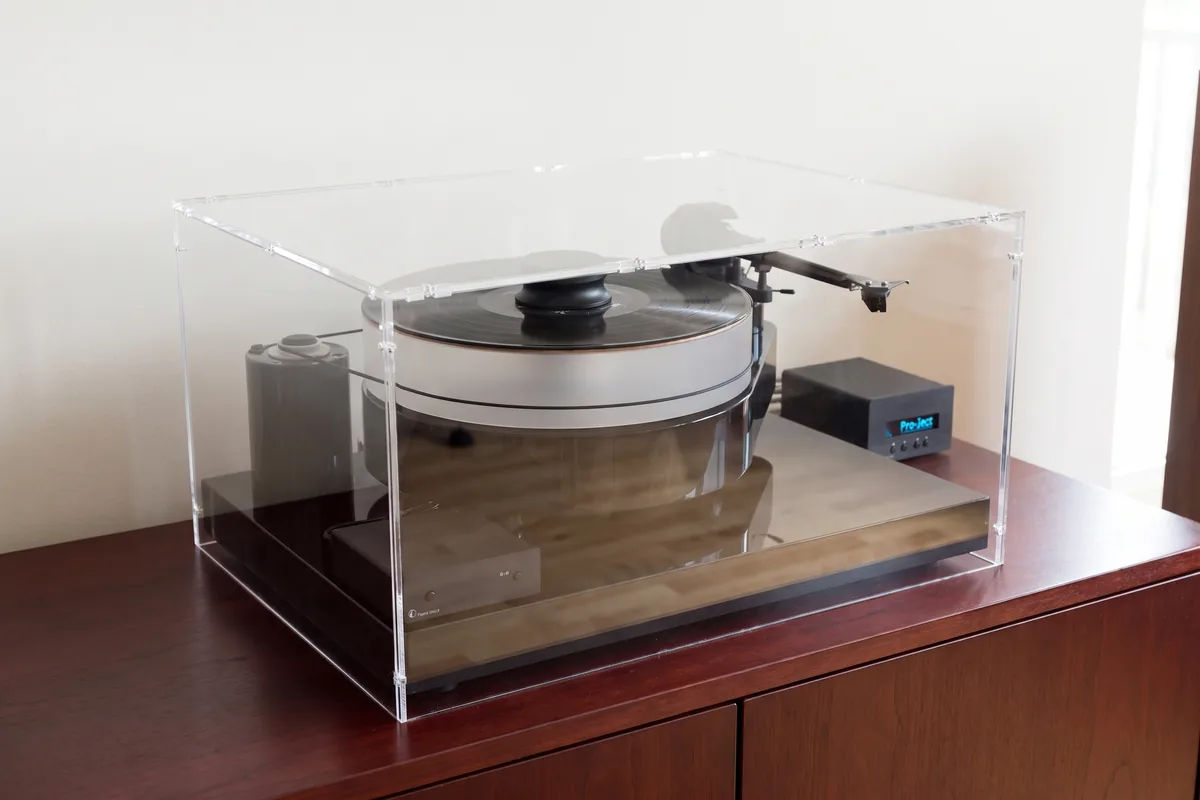
Modern turntable without a factory cover under a made-to-measure acrylic cover

Decks that are delivered without a cover

Many current high-end decks deliberately come with no dust protection. A cover made to measure protects the platter, tonearm and cartridge while the deck is idle — and is simply lifted off for listening.

Direct-drive DJ turntable under a removable acrylic cover

Direct-drive DJ decks

Turntables in the 45 cm format usually stand out in the open and gather dust accordingly. A removable cover is off quicker than a fabric slipcover — and does not scratch the surface.

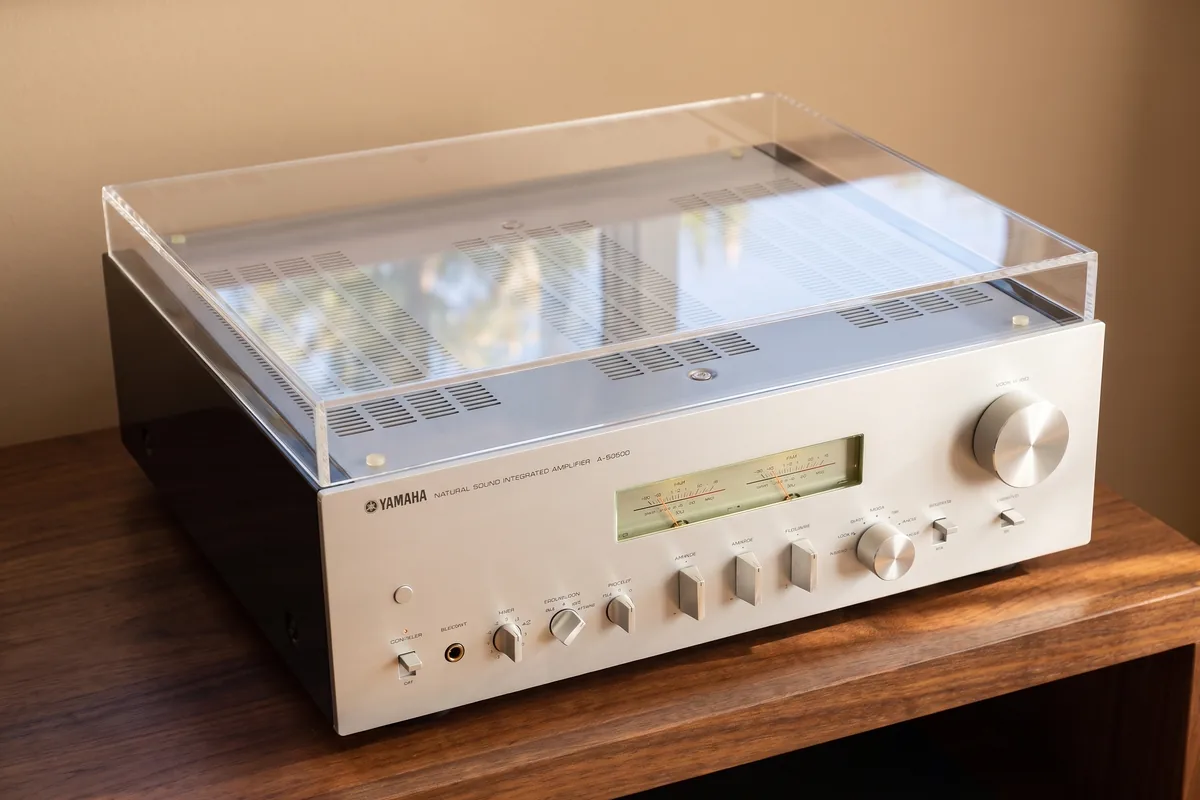
Vintage hi-fi amplifier under a low made-to-measure acrylic cover

Amplifiers, tuners and tape decks

Vintage components with wooden cheeks and exposed controls gather dust on the shelf. A low cover protects them without cluttering the look. Important: fit it only while the equipment is idle — see the note on heat further down.

Mixer with faders under a precisely fitting acrylic dust cover

Mixers and controllers

Faders and pots are the components most sensitive to dust in any studio. A precisely fitting cover can save you cleaning or replacing the controls — on a mixer almost always the more expensive route.

Close-up of an acrylic cover with a cable cut-out in the back panel for mains and signal cables

Equipment that stays connected

So that the cover sits flat even with the mains and RCA cables plugged in, you configure a cut-out in the back panel — you determine the width, height and position yourself.

→ The cable cut-out in detail

The cable cut-out: what sets the turntable cover apart from the standard made-to-measure case

Technically the turntable cover is the same construction as our made-to-measure display case — four walls, the same material thickness, the same plug-and-screw system. The difference is in the back panel: this is where a rectangular recess for the cables can be planned in. The equipment stays connected and the cover still sits flat on the surface instead of riding up on the cable loom.

How to specify the cut-out

Three values, all in millimetres (the cover dimensions themselves are entered in centimetres — which is why the mm fields are marked in yellow in the configurator):

  • Cut-out width — how wide the opening will be.
  • Cut-out height — how far it reaches upwards from the bottom edge.
  • Distance from the right — the distance from the right-hand inside edge to the start of the cut-out.

Measurement is always taken from the right, because that is the unambiguous reference edge in production. If the sockets are on the left of your equipment, convert once: distance from the right = inside width − distance from the left − cut-out width.

Worked example

A cover of 45 × 37 × 15 cm, with the RCA sockets in the middle at the rear. Cut-out width 120 mm, cut-out height 25 mm, distance from the right 165 mm — this gives a cable pass-through centred in the back panel that takes all the cables comfortably.

Close-up of the cable cut-out in the back panel of a Sora turntable cover, through which the connecting cables run out to the rear

The limits: a 15 mm frame has to remain

The cut-out can be almost any size — the only limit is a minimum frame of 15 mm that has to remain all the way round. Otherwise the back panel loses its connection to the side panels and the cover loses its rigidity. That gives exactly two formulas:

max. cut-out width = inside width − 30 mm max. cut-out height = inside height − 15 mm

In addition: the distance from the right must be at least 15 mm, and 15 mm must likewise remain free to the left of the cut-out (distance + cut-out width + 15 mm must not exceed the inside width). The configurator works this out live and tells you the maximum possible value if it does not fit.

A typical cable cut-out

Sketch of the back panel with a typical cable cut-out at the bottom centre Cut-out Distance from the right Back panel seen from outside

The standard case: a recess at the bottom of the back panel, wide enough for the mains plug and the RCA cables.

Maximum cut-out — only the frame remains

Sketch of the back panel with the maximum cut-out, where only a narrow 15 mm frame remains open rear 15 mm 15 mm Back panel seen from outside

In the extreme case the cut-out takes away almost the whole back panel — what remains is a narrow frame of about 1,5 cm as the load-bearing connection.

This maximum cut-out is not a theoretical limit but a real ordering option. It makes sense, for example, when a thick cable loom runs out to the rear, when a power-supply brick sits in the way behind the equipment, when you need air at the back for an amplifier to shed heat — or when the cover stands in a rack against the wall and nobody sees the back anyway. What you get is effectively a cover closed on three sides with a back panel frame: closed and clear at the front and sides, open at the rear.

All figures per cover, prices including VAT. The surcharge for the cut-out does not depend on the size of the cut-out.
OptionChoice in the configuratorSurcharge
Cable cut-out yes / no — with “yes”, the width, height and distance from the right in mm + 5,00 €
Back panel transparent, black or reflective (3 mm) depends on the area
Base no base · standard (slip-over version, with overhang) · flush — each transparent or black depends on the area
Quantity 1 to 99 covers in the same configuration graduated pricing in the configurator
Configure a cover with a cable cut-out →

How to configure your turntable cover in 3 minutes

The online configurator guides you step by step and shows the price in real time — no data sheet, no queries needed.

Measure the equipment

Width and depth of the footprint including the feet and any protruding controls, height up to the highest point.

Do not forget the counterweight!

Enter the inside dimensions

Enter the equipment dimensions plus 1–2 cm of clearance as the inside dimensions — that is the space for your equipment.

Inside dimensions, not outside dimensions!

Base, back panel, cut-out

Base optional, back panel transparent/black/reflective, cable cut-out as required.

Order

Price in real time. Delivery in approx. 8 working days — assembly in a few minutes.

The highest point is rarely the platter

With turntables the height is almost always underestimated: what counts is the counterweight, the tonearm lift, any cover hinges left in place and the plinth — not the platter. Measure at rest with a record on the platter and you are on the safe side. The values given are always inside dimensions; the outside dimensions come out slightly larger because of the material thickness and the plug-and-screw system:

outside width = inside width + 14 mm outside depth = inside depth + 8 mm outside height (without base) = inside height + 7 mm

With a base the usable inside height is reduced: transparent base −4 mm, black base −6 mm. Tip: allow 1–2 cm of clearance all round — otherwise, sooner or later, you will catch the counterweight when putting the cover down, and that is the part you least want to knock.

Which dimensions are possible

The inside dimensions run from 6 cm to 110 cm in width and height, and up to 55 cm in depth. Of width, depth and height, only one dimension may exceed 50 cm — for turntables, amplifiers, tape decks and mixers that is plenty of room. If you need more (for a whole system or a long rack, say), use the oversize acrylic display case or the split tunnel display case — both without a cable cut-out, but with larger maximum dimensions.

Not sure which inside dimensions suit your type of equipment?

Our Hi-Fi collector’s world has a table of typical footprints with matching suggested inside dimensions — from entry-level decks through subchassis classics and DJ formats to receivers on the 43 cm grid.

To the table of equipment dimensions →

Open the configurator now →

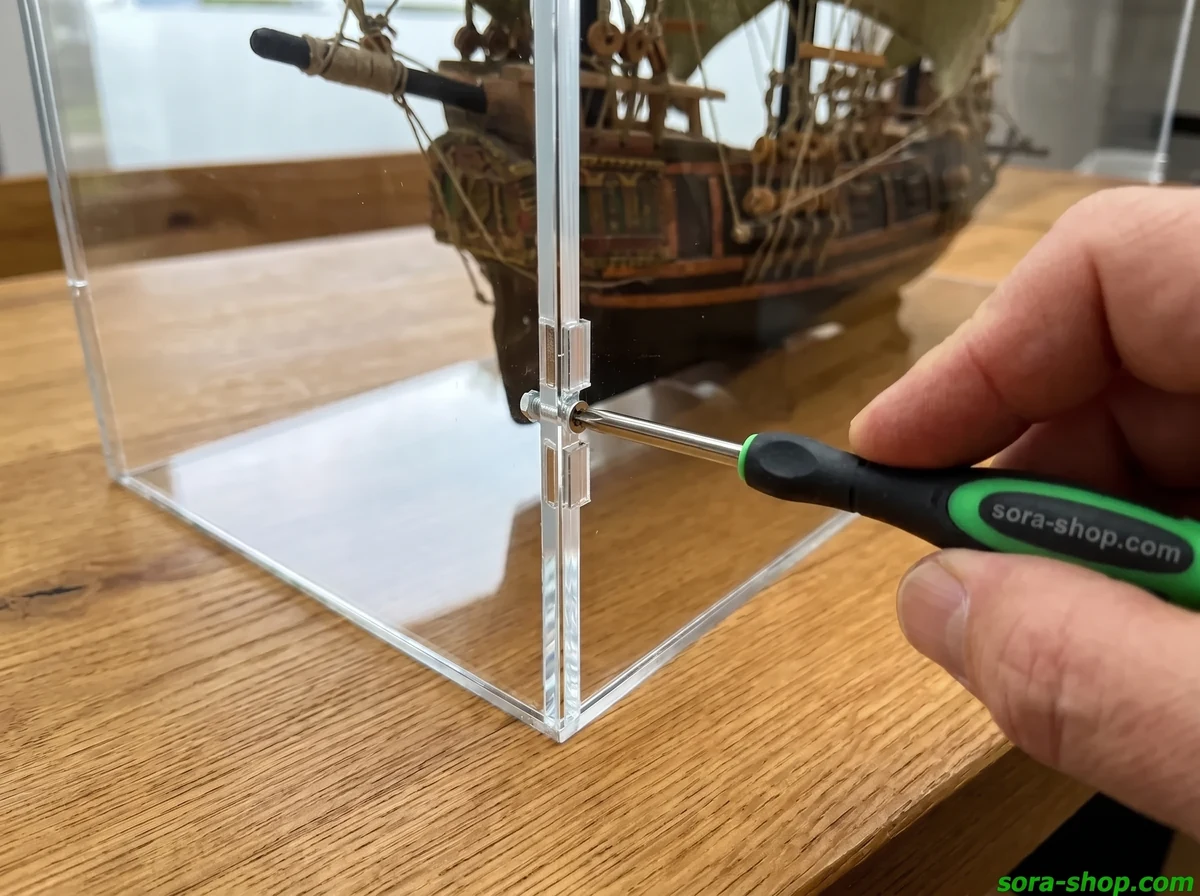
The Sora plug-and-screw system: nothing glued, fully demountable

We do not glue and we do not cast in one piece: the cover is delivered as a construction kit with small screws and nuts. You assemble it yourself in a few minutes — on a turntable cover the back panel with the cut-out is simply one of those individual parts.

By the way: our plug-and-screw system is no passing fashion – we developed it ourselves more than 20 years ago and had it officially registered as a utility model. View the original document as a PDF ↗

Safe shipping Even large covers arrive undamaged because they travel flat.
Easy to move Unscrew, pack up, reassemble.
Spare parts A scratched front panel? Just reorder that one part.
Made in Germany Over 20 years of manufactory experience.
Close-up of the Sora plug-and-screw system with small screws in the corner of the acrylic glass

Explained on video: assembly and the plug-and-screw system

In just under 5 minutes our explainer video shows the plug-and-screw system, the assembly and the logic of the configurator. It applies to every cover variant — the turntable cover differs only in its back panel with the cut-out.

Material and quality

We work exclusively with high-grade industrial-quality PMMA acrylic glass – crystal clear, lightfast and in the lasting Sora quality.

4 mm transparent acrylic glass
3 mm black & reflective elements
> 92 % light transmission
ca. 8 working days delivery time

Acrylic glass or Plexiglas — what is the difference?

Practically none: both terms are searched for, and both mean the same material. A turntable cover made of Plexiglas and a turntable cover made of acrylic glass both consist of PMMA (polymethyl methacrylate) — the clear, break-resistant plastic from which the original covers of most hi-fi manufacturers were made as well.

Note on the term “Plexiglas”: Plexiglas® is a registered trade mark of Röhm GmbH for PMMA semi-finished products. We use the term here purely descriptively, because in everyday language it has become a synonym for clear acrylic glass. We make our covers from high-grade PMMA acrylic glass from various manufacturers.

Lightfastness and UV behaviour

The acrylic glass we use does not yellow and does not become brittle even after years in direct sunlight — precisely the point at which many old original covers failed. Important: the acrylic glass itself is UV-stable, but it offers no UV protection for the equipment underneath. Wooden plinths and printed dials still fade in direct sunlight.

Three things hi-fi customers should know beforehand

Heat: the cover is for idle time only

Amplifiers, receivers and above all valve equipment give off considerable heat in operation. That heat builds up under a closed acrylic cover — so take the cover off before switching on. With valve amplifiers this applies without exception: the cover is dust protection for the time when the equipment is switched off. A generous cable cut-out in the back panel helps air circulation, but does not replace it.

A removable cover instead of a hinged lid

We manufacture removable dust covers, not hinged lids — the plug-and-screw system is designed for straight edges. In practice this is no disadvantage for most users: the cover is lifted off to put a record on anyway, and with no cover above the tonearm there is no resonating surface during play.

Spare parts instead of a new cover

If only one panel of a Sora cover is scratched or broken, you reorder that individual part instead of the complete cover — the back panel with the cable cut-out is available separately too, through the spare part configurators. That is one of the reasons why we screw rather than glue.

Note on trade marks: Technics, Pro-Ject, Rega, Thorens, Dual, Pioneer and all other brands mentioned here belong to their respective rights holders. Sora Shop is an independent manufactory and has no business relationship with any of these manufacturers. We make covers to the dimensions you give us — these are not original spare parts.

What you should know after delivery

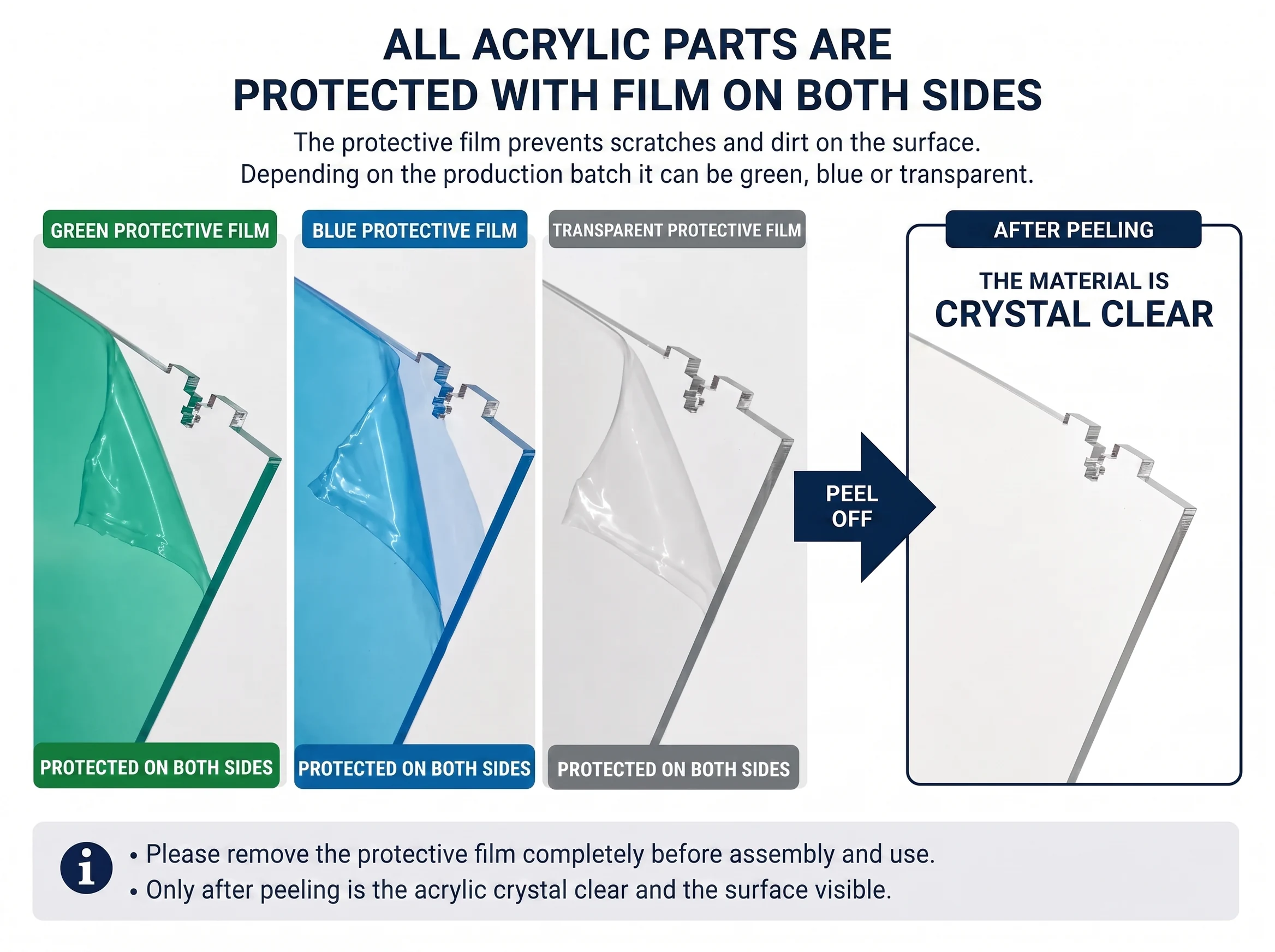
Do not be alarmed: the protective film

When your parcel arrives, the acrylic parts will probably look blue, green, white or even scratched. That is the protective film covering every part on both sides to prevent scratches during production and shipping (reflective elements are filmed on the front only).

Simply lift the film off at one corner with your fingernail – acrylic cannot be scratched by a fingernail. Underneath, crystal-clear, flawless acrylic glass comes to light.

Protective film being peeled off an acrylic panel, crystal-clear acrylic visible underneath

Assembly instructions

The same instructions apply to every cover variant — made-to-measure display case, oversize, tunnel case and turntable cover.

Assembly instructions (PDF) →

Made to measure – no right of withdrawal

This item is manufactured individually for you, to the dimensions and options you choose, only after you have placed your order. Under section 312g(2) no. 1 of the German Civil Code (BGB), such custom-made items are excluded from the statutory right of withdrawal; exchange or return is therefore not possible. Please check your measurements carefully before ordering. Your statutory warranty rights in the event of manufacturing faults or transport damage are not affected – see our Right of Withdrawal page for details.

Unsure about the dimensions? The Sora adviser can help.

Equipment dimensions, the position of the cut-out, delivery times — the bot is trained on every cover topic and answers straight away. You will find it at the bottom left of this page at any time.

Frequently asked questions about made-to-measure turntable covers

How do I measure my turntable correctly for the cover?

Width and depth of the footprint including the feet and any protruding controls, and the height up to the highest point — that is usually the tonearm counterweight or the tonearm lift, not the platter. Measure at rest with a record on the platter and add 1–2 cm of clearance. The values you enter are always inside dimensions.

What is the cable cut-out and what does it cost?

A recess in the back panel through which the mains and signal cables run out to the rear — the cover then sits flat even while the equipment stays connected. You give the width, height and the distance from the right-hand inside edge in millimetres. The surcharge is a flat 5,00 € per cover, whatever the size of the cut-out.

How large can the cable cut-out be at most?

A 15 mm frame has to remain all the way round the cut-out. It follows that:

  • maximum cut-out width = inside width − 30 mm
  • maximum cut-out height = inside height − 15 mm
  • distance from the right-hand inside edge at least 15 mm

In the extreme case the back panel is therefore almost completely open and only a narrow frame of about 1,5 cm remains — handy with a thick cable loom, with equipment that gives off heat, or when the cover stands with its back to the wall. The configurator checks the values live and states the maximum possible one if they do not fit.

Can the cut-out also sit on the left or in the middle?

Yes, the position is freely selectable — it is simply always measured from the right-hand inside edge, because that is the unambiguous reference edge in production. For a cut-out on the left, convert once: distance from the right = inside width − distance from the left − cut-out width.

Does the cover open like the original hinged cover?

No. We manufacture removable dust covers that are placed over the equipment – not hinged covers. To put a record on, you lift the cover off. Many vinyl listeners prefer that anyway, because there is then no resonating surface above the tonearm during play.

Which dimensions are possible?

Inside dimensions from 6 cm to 110 cm in width and height, and up to 55 cm in depth. Of width, depth and height, only one dimension may exceed 50 cm. For larger objects there are the oversize acrylic display case and the tunnel display case – both, however, without a cable cut-out.

Are the dimensions in the configurator inside or outside dimensions?

Always inside dimensions – that is, the space actually available to your equipment. The outside dimensions come out slightly larger because of the material thickness and the plug-and-screw system:

  • outside width = inside width + 14 mm
  • outside depth = inside depth + 8 mm
  • outside height (without base) = inside height + 7 mm

With a base the usable inside height is reduced: transparent base −4 mm, black base −6 mm.

What base options are there?

Three variants, each transparent or black:

  • No base – the cover is slipped over the equipment and stands on the furniture. With turntables the most common case.
  • Standard base (slip-over version) – it overhangs by 1,6 cm in width and 1,2 cm in depth, with rounded corners.
  • Flush base – exactly rectangular (90° cut), finishing flush with the outside dimensions without any overhang.
Is a turntable cover made of Plexiglas the same as an acrylic cover?

In everyday language yes – both mean the material PMMA. Plexiglas® is, however, a registered trade mark of Röhm GmbH. We manufacture from high-grade PMMA acrylic glass, the same material from which Plexiglas® semi-finished products are made.

May the equipment run underneath the cover?

With a turntable the cover comes off for play in any case. With amplifiers, receivers and above all valve equipment the rule is: fit the cover only while the equipment is idle – the waste heat builds up under a closed acrylic cover.

Will the new cover yellow eventually as well?

No. The PMMA acrylic glass we use does not yellow and does not become brittle – unlike many old original covers. It does not, however, offer UV protection for the equipment underneath: wooden plinths and printed dials still fade in direct sunlight.

Why do the delivered parts look blue, green or scratched?

That is the protective film. All acrylic parts are covered on both sides to prevent scratches during production and shipping (reflective parts on one side only). Lift the film off at one corner with your fingernail — acrylic cannot be scratched by a fingernail.
Real customer photos from hi-fi corners and listening rooms

No renderings: this is what Sora covers look like on real equipment. A selection from the photos that customers send us after delivery — the complete gallery currently holds around 700 pictures.

All photos were provided to us by Sora customers and published with their consent.

More than just the turntable cover

Turntables & Hi-Fi — the collector’s world

Equipment dimension table, customer photos from hi-fi corners and everything about replacement covers for vintage equipment.

To the Hi-Fi collector’s world →

Made to Measure Display Case

The basic variant without a cut-out — for models, collectables and everything that needs no cable pass-through.

To the display case guide →

A rack for the record collection

Made-to-measure racks for LPs, CDs and media — same production, same material thickness.

To Display Cabinets & Racks →

Spare parts for Sora covers

Reorder individual panels instead of the complete cover — including the back panel with a cable cut-out.

To the spare parts →

Your new turntable cover is three minutes away

Enter the dimensions, place the cable cut-out, see the price in real time.
Made in a German manufactory, delivery in approx. 8 working days.

Configure now →